What Is a Tiny House? Key Definitions + Tiny House vs ADU vs Cabin vs Small Home
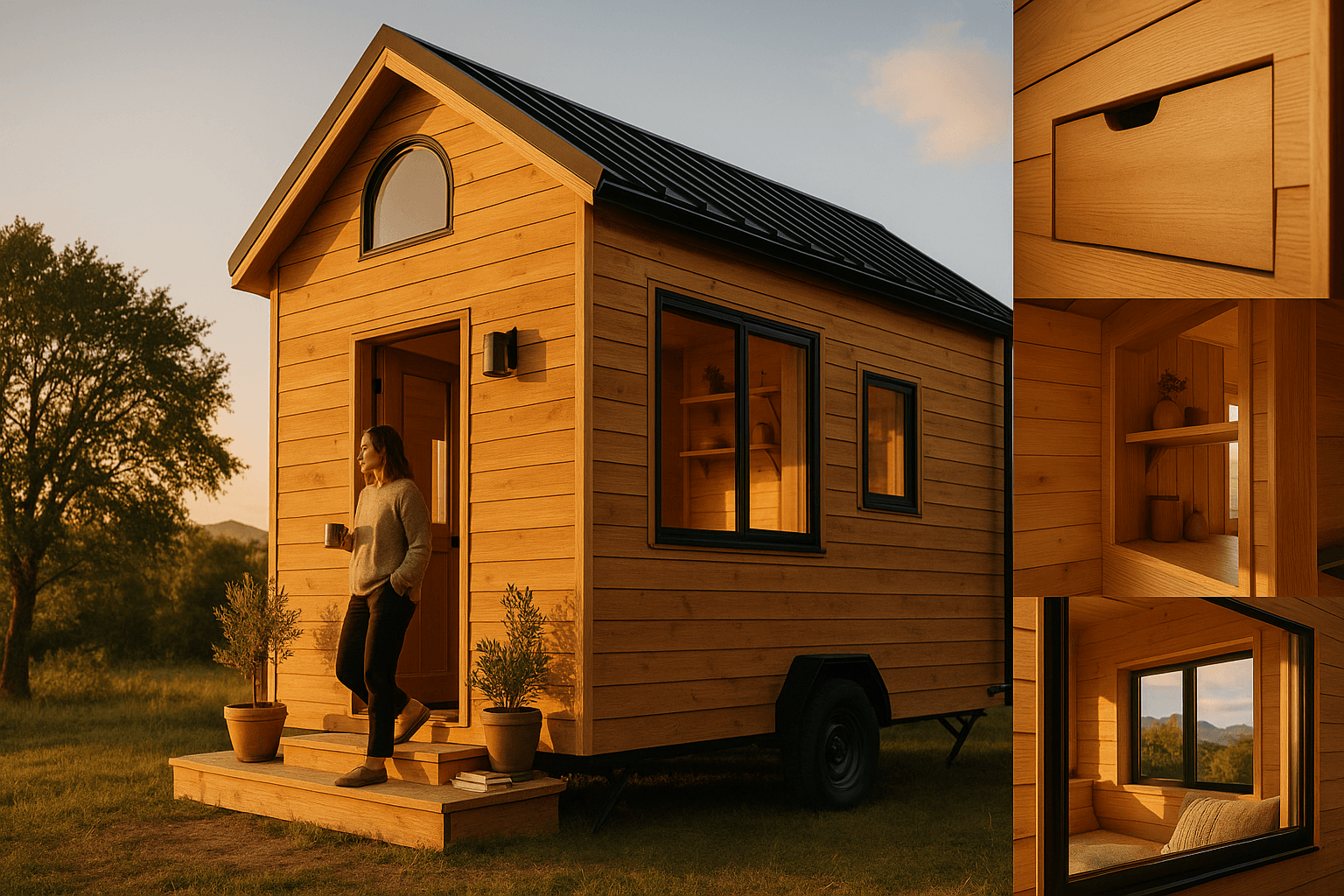
Small-home labels create confusion—but the differences shape what you can build, where you can place it, and how you connect utilities. A "tiny house" is mostly a size + design philosophy, while terms like ADU and micro-apartment are defined by legal relationships and building types.
Below are practical definitions with realistic size ranges and a comparison framework—then we'll show how TinyHouses helps you define your build with AI-powered design that picks the right category and generates concept plans aligned with your location and lifestyle.
Tiny house: the practical definition
A tiny house is an intentionally small dwelling—typically 10–40 m² (100–400 ft²) of internal floor area—designed for comfortable living with less space.
What makes it "tiny" isn't just square meters—it's the design approach:
- Multi-use spaces (dining table becomes desk, stairs become storage)
- Compact but complete living (kitchen, bathroom, sleeping, living)
- Purposeful minimalism (smaller footprint without sacrificing modern comfort)
What a tiny house is not:
- Not automatically mobile (many sit on foundations)
- Not automatically off-grid (many connect to city utilities)
- Not automatically legal everywhere (definitions vary by location)
At TinyHouses, we treat "tiny house" as an umbrella term—and help you decide which specific type fits your situation.
Tiny house on wheels (THOW): mobile living
A THOW is built on a trailer chassis. In many places it's regulated like a trailer or RV—even when it looks like a home.
Size reality: Usually 10–40 m², but constrained by road-legal width, height, and weight limits.
Where THOWs shine:
- You want mobility (or the option to move)
- You like trying different locations before committing
- You can navigate RV-style regulations
Common challenges:
- Variable legality: "built like a home, regulated like a trailer"
- Full-time living restrictions in some areas
- Insurance and financing can be vehicle-focused
- Hookups may require RV-style connections
How TinyHouses helps: Use our AI designer to set mobility = yes, then generate concepts that account for towing constraints, weight limits, and compact storage solutions.
Tiny house on foundation: permanent tiny living
A foundation tiny house maintains the 10–40 m² size but becomes a permanent structure.
Why people choose this:
- Often clearer building-code pathway than THOW
- Easier standard utilities (grid power, plumbing, sewer)
- More compatible with traditional financing and insurance
Tradeoffs:
- You lose mobility
- Land rules and setbacks become the main constraint
How TinyHouses helps: In our AI "Define Your Build" flow, set foundation = yes and select your site type. Generate a concept plan plus a checklist for local validation.
Quick definitions: the other options
Small house
A small house is a conventional home that's simply smaller—often 40–120 m² (430–1,300 ft²).
- Built to standard residential codes
- Not necessarily minimalist—just smaller
- Often easier for long-term family living
Cabin
A cabin is defined by context and use rather than size:
- Often rural, wooded, or coastal
- Frequently seasonal or secondary dwelling
- Can be tiny or large—"cabin" signals retreat living
Micro-apartment
A micro-apartment is a compact unit in a multi-unit building, typically 15–35 m² (160–380 ft²).
- Not mobile
- Governed by apartment regulations
- Usually in dense urban areas
ADU (Accessory Dwelling Unit)
An ADU is a secondary dwelling on the same lot as a primary home.
- Size range: often 20–90 m² (215–970 ft²)
- Key trait: it's accessory—legality depends on the primary residence
- Can be detached, attached, or converted space
Comparison table: which type fits your goals?
| Type | Size | Mobility | Legal Category | Best For | Main Challenge |
|---|---|---|---|---|---|
| THOW | 10–40 m² | High | Vehicle/RV | Flexibility, testing locations | Parking legality |
| Foundation Tiny | 10–40 m² | None | Permanent dwelling | Small footprint home | Zoning minimums |
| ADU | 20–90 m² | None | Secondary unit | Backyard home, rental income | Local ADU rules |
| Cabin | Variable | None | Varies | Retreat living | Access, utilities |
| Micro-apartment | 15–35 m² | None | Apartment unit | City living | Availability, costs |
| Small House | 40–120 m² | None | Standard house | Conventional ownership | Higher costs |
Which should you choose? Fast decision guide
"I want to move it (now or later)"
Choose: THOW
- Design around real towing constraints using TinyHouses AI
"I want a backyard home for family or rental"
Choose: ADU
- Use our AI flow to select existing lot + secondary unit
"I want tiny city living without owning land"
Choose: micro-apartment or rent a tiny house
- Test the lifestyle with TinyHouses marketplace rentals
"I want a nature-first retreat"
Choose: cabin
- Design cabin-style tiny homes with our AI, then browse matching builders
"I want a normal home—just smaller"
Choose: small house or foundation tiny
- Our AI shows how space needs affect minimum comfortable size
How TinyHouses defines your build
Most tiny living failures come from choosing the wrong category for your land, goals, or local rules. TinyHouses bridges definition → design → real options.
Our "Define Your Build" process:
You input: Location, site type, mobility needs, intended use, budget, off-grid preference, occupancy, and climate
Our AI outputs:
- Recommended category (THOW vs foundation vs ADU vs cabin-style)
- Concept plan (size target + layout + system assumptions)
- Local verification checklist (questions for your municipality or builder)
Then explore: Matching rentals, builders, and listings worldwide to try the lifestyle or buy with confidence.
FAQ
What size officially counts as a "tiny house"? Commonly 10–40 m² (100–400 ft²). Official definitions vary by region—many places don't legally define tiny houses as distinct.
Is a THOW legally an RV? Often yes—treated like a trailer or RV in many jurisdictions. Full-time living rules vary significantly.
What's the difference between a tiny house and an ADU? Tiny house = size/design concept. ADU = legal relationship (secondary dwelling on same lot as primary home).
Can an ADU be tiny? Yes—if your tiny design complies with ADU rules on a lot with a primary residence.
Which is easiest to permit? Often ADUs (in areas with strong ADU policies) or foundation tiny houses. THOWs can be most ambiguous. TinyHouses helps you prepare the right questions.
Do I need land for a tiny house? For placement, yes—or legal site arrangements. Without land, consider micro-apartment living or renting a tiny house to test the lifestyle.
What utilities do tiny houses use?
- Electric: Grid or solar + batteries
- Water: City, well, or tank systems
- Wastewater: Sewer, septic, or holding tank
- Heat/cooking: Electric or propane
TinyHouses helps you choose realistic system assumptions during design.
The bottom line
A tiny house is compact, intentional living in 10–40 m²—but real-world success depends on mobility (wheels vs foundation), site context (standalone vs accessory), and legal classification.
Define these three things early, and your path to tiny living gets dramatically simpler.
Design your perfect tiny home with AI
TinyHouses AI helps you define your category and visualize concepts in minutes—then explore rentals or builds that match your vision.
Start designing: TinyHouses.to/design