The 'Underconsumption' Trap: How to Downsize for Tiny Living Without Rebuying Everything
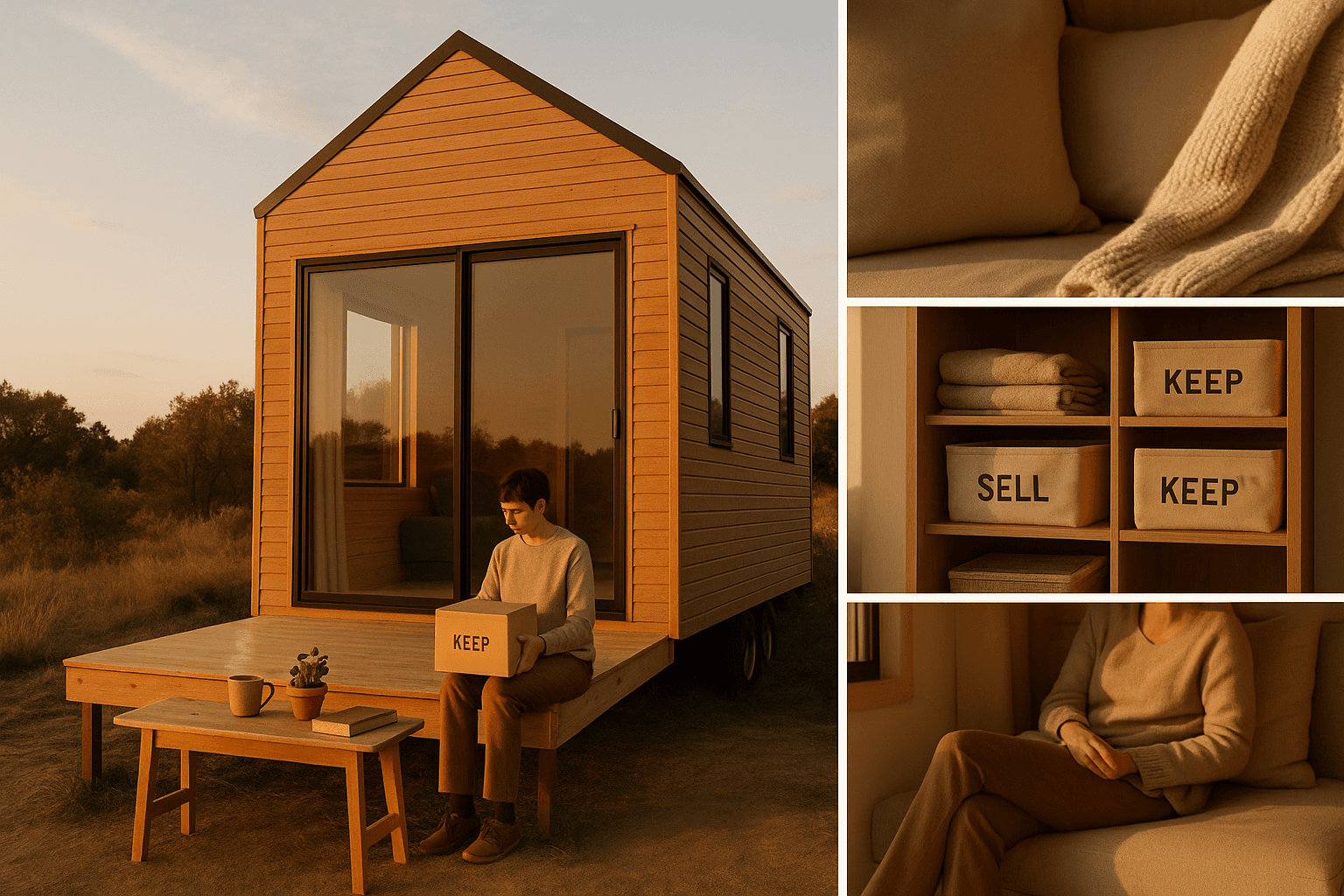
Tiny living feels freeing when you downsize to a measurable storage target—not when you purge for a minimalist vibe and then panic-buy "tiny-friendly" replacements. The practical path is: decide what functions your life needs, assign every item to Keep / Replace (later) / Digitize / Store outside, and use a stuff budget so your future tiny house is designed around your real routines.
Why "purge first" backfires in tiny houses
In a normal-size home, missing one tool or pan is annoying. In a tiny house, it becomes daily friction—because every routine is compressed into the same few zones.
That's why aggressive decluttering often creates a predictable loop:
- Purge fast (motivated by reels, a move deadline, or shame)
- Move in and hit "missing-item pain" (cooking, sleep, work, weather)
- Emergency buy "tiny versions" (collapsible, modular, multi-use)
- End up with more cost, more waste, more micro-clutter
The core mistake: people downsize without a systems plan—and then the tiny house forces the system, expensively.
The waste angle nobody mentions
A lot of "decluttered" items don't become someone else's treasure. Many categories still end up trashed or exported. The purge → rebuy cycle isn't just stressful—it can also increase your footprint.
Tiny living is supposed to be gentle on the earth. The lowest-waste approach: keep what already works, replace only after living tiny, and design storage around what you truly use.
Storage is a math problem, not a vibes problem
Minimalism content sells a feeling. Tiny houses demand a number.
Practical anchors:
- Most tiny homes: ~100–400 sq ft (storage is the first failure point)
- Medium moving box: ~3 cubic feet
- Bankers box: ~1–1.5 cu ft
- Closet rod (3 ft section): roughly 15–25 hanging items
If your tiny house is on wheels, "too much stuff" becomes a safety issue
Over-keeping isn't only visual clutter—on a Tiny House on Wheels it affects:
- Weight limits (GVWR and axle ratings)
- Weight distribution (handling and braking)
- Where heavy categories live (tools, books, water)
This is why we encourage planning storage by category weight, not only by aesthetics, when you're designing or choosing a model.
The "tiny-friendly product" category is a trap
Collapsible and modular gear looks perfect in a 12-second video. Real life is different.
Common disappointments:
- Costs more per use than what you already own
- Creates micro-clutter (extra lids, attachments, stacking systems)
- Adds friction (collapsible cookware that's annoying every day)
- Optimizes for looking tidy, not for function density
Function density = how many real tasks an item supports in your life.
Tiny living works best when you protect your high-density items and only "tiny-ify" after you've measured what's actually needed.
The 4-bucket decision framework
Here's the rule that stops deprivation and stops the rebuy cycle:
Every item gets exactly one outcome. No "maybe" piles.
1) KEEP (for move-in)
Keep means: "This earns its footprint in my daily/weekly life."
Criteria:
- Used weekly or monthly
- High satisfaction (makes routines easier, calmer, better)
- Hard/expensive to replace well
- Multi-tasking (supports multiple routines)
When you Keep items, you're creating design inputs:
- Real chef's knife + cutting board? You'll want continuous counter space
- Stroller + hiking carrier? You'll need an entry "dirty zone" and likely an exterior locker
- Full-time laptop setup? You'll want a desk + cable + filing zone
2) REPLACE (but only after you move)
Replace is the most important anti-rebuy bucket because it prevents panic shopping.
Choose Replace when:
- You need the function, but your current item is oversized or duplicative
- You can survive with what you have for now, then upgrade intentionally
Non-deprivation rule:
- Keep the function now
- Replace later using specs (dimensions, wattage, nesting ability), not vibes
Simple policy: "No tiny-optimized shopping until you've lived 30–60 days in your tiny setup."
Our AI design flow can help you set those specs early—cabinet widths, drawer depths, closet inches—so when you do replace, you buy exactly what fits.
3) DIGITIZE (access needed, physical not needed)
Digitize when you need information access, not the physical object.
Good digitize categories:
- Paperwork and household records
- Manuals, warranties, receipts
- Old photos you don't physically display
- Reference books you don't actually re-read
Quick protocol:
- One folder system (not five apps)
- Naming:
YYYY-MM - Category - Description - Two backups (cloud + external drive)
When you digitize, you reduce required drawer/cabinet volume, which can translate into a simpler layout—or more room for what you truly love.
4) STORE OUTSIDE (strategic, not shameful)
Store outside is the best-kept secret of non-stress tiny living—especially in year one.
Use it for:
- Seasonal gear
- High-value, low-frequency tools
- Sentimental archives you don't want to "decide forever" today
Options that align with a small footprint:
- Single labeled tote per category at family's house
- Micro-storage unit for a defined transition window
- Shared storage with friends/community
Knowing what will live off-site helps you choose the right tiny home—some models include exterior lockers, gear walls, or utility sheds.
The "Stuff Budget": setting boundaries without deprivation
A stuff budget isn't moral virtue. It's capacity planning.
Instead of "I should own less," you decide:
- My home has X containers for clothing, kitchen, work, hobbies
- When they're full, something exits
Container list example
| Category | Container limit | Why this works |
|---|---|---|
| Daily clothing | 1 closet rod + 2 drawers | Prevents wardrobe creep; easy laundry |
| Outerwear/shoes | 1 bench + 1 hook rail | Keeps entry functional |
| Kitchen tools | 2 drawers + 1 wall rail | Protects counter space |
| Pantry | 1 cabinet + 1 bin | Stops "backup food" overflow |
| Work/office | 1 drawer + 1 file bin | Keeps cables/paper contained |
| Hobby | 1 tote each | Joy stays joyful, not sprawling |
| Sentimental | 1 bankers box per person | Enough to remember, not enough to drown |
Example stuff budgets (realistic, not aesthetic)
Solo remote worker (modern + minimalist)
- Clothing: ~25–35 hang items + 4–6 drawers
- Work: dedicated desk zone + 1 file bin
- Kitchen: keep the reliable daily set; replace later only if needed
Couple with outdoor gear (nature-first lifestyle)
- Add: exterior locker or under-floor storage requirement
- One tote per sport + one shared tool crate
- Duplicate rule: keep two only when it removes daily friction
Small family
- Storage must include: entry "drop zone," linen capacity, toy/book limits
- Keep comfort items to avoid "emergency purchases"
Once you define your stuff budget, you can design cabinetry to match—or browse tiny homes with storage features that fit your life.
A practical downsizing sequence
The order matters. This sequence prevents deprivation and rebuying.
Step 1: Design your routines
Write a simple list:
- Weekday breakfast + coffee
- Work/school blocks
- Laundry rhythm
- Dinner routine
- Weather realities
- Hosting needs
This routine map becomes your layout priorities.
Step 2: Inventory by category (not by room)
Categories:
- Kitchen
- Clothing
- Bedding
- Bathroom
- Work/tech
- Tools
- Outdoor gear
- Kids
- Sentimental
Step 3: Assign the 4 buckets—fast
Do not "organize" first. Decide first:
- KEEP
- REPLACE (later)
- DIGITIZE
- STORE OUTSIDE
Step 4: Set your storage target
Pick containers, drawers, rod length, shelf length.
One simple rule: If it doesn't fit the container, something must exit.
Step 5: Live-test with "trial boxes" for 30 days
Box up "maybes" and label the date.
- Open it in 30 days? Probably Keep/Store Outside
- Don't open it? Probably Donate/Sell
Step 6: Replace only after you can measure
When you do replace, use a spec list:
- Max width/height/depth
- Nesting/stacking requirements
- Power draw (if off-grid)
- Cleaning friction
When you design with us, you can set storage dimensions first—then replacements become straightforward purchases.
Red flags that guarantee the rebuy cycle
- Buying organizers before you know cabinet dimensions
- Decluttering sentimental items first (emotionally exhausting = bad decisions)
- Purging core comfort: bedding, weather gear, daily cooking tools
- Replacing functional items just because they're not "aesthetic"
- Trying to "go minimal" and "move house" at the same time
How TinyHouses makes this easier
Treat decluttering as design input, not self-punishment. When the design matches your life, you don't need to shop your way out of friction.
The AI Inventory Method
Input:
- Rough counts by category ("12 mugs," "2 cast iron pans," "18 hanging shirts")
- Notes about routines (remote work, kids, camping weekends)
- Optional photos of problem areas
What you get back
TinyHouses translates your inventory into:
- Storage volume targets (drawers, shelves, closet rod length)
- A realistic stuff budget that matches actual layouts
- Suggested storage zones (entry drop zone, galley, under-bed, exterior lockers)
Why this prevents "rebuying everything"
When you know your storage capacity and zones:
- You stop purging blindly (no deprivation)
- You stop buying blindly (no "tiny gadget" spiral)
- You can compare listings by fit, not by looks
Downsize to a number. Then design to that number. That's the calm way.
The 10-point anti-rebuy rulebook
- No replacement shopping for 30–60 days after move-in
- Keep the function first; optimize later
- One tote per hobby
- One bankers box per person for sentimental
- Digitize paperwork with one system + two backups
- Entry zone is sacred: shoes/coats/bags must have a home
- Kitchen rule: keep what you use weekly
- Don't buy organizers until you have actual dimensions
- Duplicates allowed when they reduce daily friction
- If it doesn't fit the container, something exits
Ready to turn your inventory into a storage target? Our AI design generator helps you create realistic layouts before you purge or rebuy. Design your dream tiny house at tinyhouses.to/design.