The Underconsumption Trend Sounds Cute—Until You Move Tiny (Here's the Filter That Actually Works)
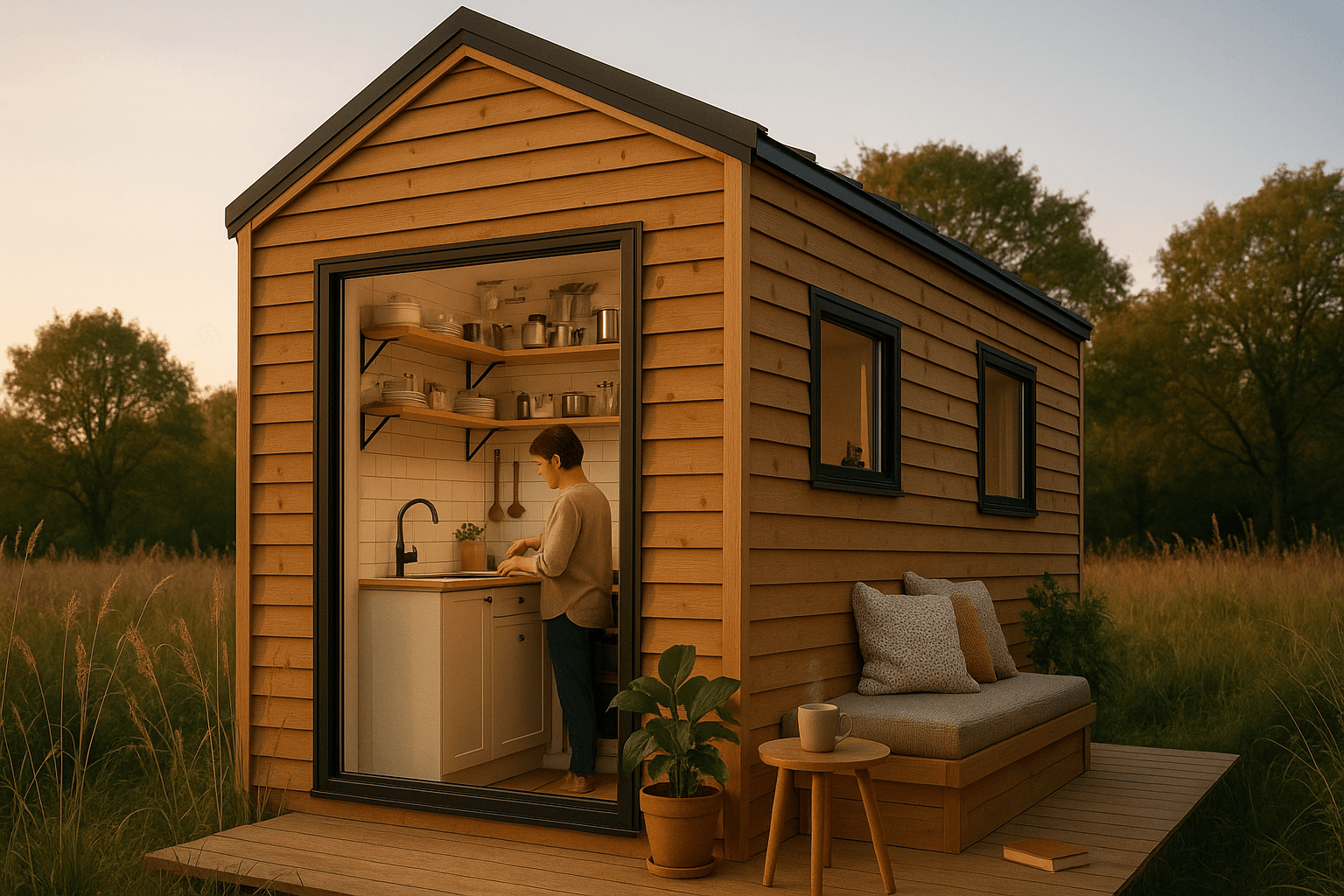
Underconsumption works in a big home because you can hide the "maybe" items. In a tiny house (often 100–400 sq ft), you can't. The difference between "freeing" and "deprived" usually comes down to one thing: surfaces—your counters, table, entry ledge, and floor pathways. If an item doesn't earn a specific surface or defined storage volume, it becomes daily friction.
Why tiny living breaks aesthetic underconsumption advice
Most viral underconsumption tips are mindset-first ("just buy less") or vibe-first ("make it look calm"). Tiny living is function-first.
In a small space:
- Every surface is a work zone. Your counter isn't decor; it's prep space, dish-drying, coffee station, sometimes laundry folding.
- Pathways matter more than totals. A few objects in the wrong spot can block your flow.
- Access friction kills use. If you must move 3 things to reach 1 thing, you'll stop using it (and you'll resent storing it).
The homes that feel luxurious aren't just pretty—they protect clear surfaces and make daily items effortless to put away.
The filter that actually works: The One-Surface Rule
The One-Surface Rule (tiny-house version)
Everything you own must earn either:
- A named surface (a specific section of counter, a shelf, a desk zone, a bedside ledge), or
- A defined volume (one bin, one drawer, one cabinet, one overhead compartment)
…and it must have an access level:
- Daily: reachable with zero item-moving
- Weekly: reachable with 1 move
- Seasonal: can be stored deeper or off-site
If you can't answer "where does this live?" with a specific surface or volume, the item doesn't get to stay—because in a tiny house it will quietly steal your life through clutter creep.
The simple math that makes it real
Use these three "costs" when deciding:
| Cost | What it means in tiny living | Quick way to estimate |
|---|---|---|
| Footprint cost | How much precious surface/floor it occupies | % of your counter/table it consumes |
| Volume cost | How much cabinet/bin space it eats | "It takes half a drawer" or "one full bin" |
| Access cost | How annoying it is to retrieve/put away | Number of moves to get it |
If your essentials require too much footprint or volume, you need to redesign the storage—or refine the keep list before you commit to a floorplan.
How to apply the One-Surface Rule (step-by-step)
Step 1: Name your non-negotiable surfaces (the "life stations")
Write these down as if you're labeling zones on a floorplan:
- Entry drop zone (keys, shoes, bag, wet jacket)
- Cook zone (clear prep space + cooking tools)
- Eat/work zone (table or desk surface)
- Hygiene zone (bathroom vanity/medicine)
- Sleep zone (bedside essentials)
- Utility zone (laundry hamper, cleaning kit, tool kit)
Step 2: Set surface budgets (so "clear" stays clear)
A tiny house works best when you protect clear space on purpose.
Try these default budgets:
- Kitchen counter: keep 70% clear at all times
- Table/desk: keep 80–90% clear (because it needs to transform)
- Entry surface: keep 50% clear (drop zone is allowed to be busy—but contained)
If an object violates the budget, it must move into a defined volume or leave.
Step 3: Run every item through the 4-question filter
For each item, answer quickly:
- Where does it live? (name the surface or the exact bin/drawer)
- Is it real-life use or aspirational? (used in the last 30–90 days?)
- What's the access cost? (how many moves to retrieve/put away?)
- What's the replacement plan?
- Cost to rebuy
- Time to get it
- Borrow/rent option
If you can't answer #1, it's not "keep." It's "homeless clutter."
Step 4: Choose one of three outcomes (no limbo pile)
Create three labeled outcomes:
- Keep (with a home): assigned surface/volume + access level
- Keep seasonal/off-site: camping gear, winter boots, holiday items
- Remove: sell, donate, recycle, or gift
Tiny-house reality checks: what NOT to purge blindly
Don't purge these blindly (regret-proof essentials)
These categories are small-footprint but high-leverage:
- Seasonal layers: one real winter system (coat, boots, base layers)
- Basic tool + repair kit: tiny homes need small maintenance
- Paperwork essentials: IDs, insurance, property docs, medical records (go digital where possible)
- One formal outfit: weddings, funerals, interviews happen
- Hobby keystone items: keep the one thing that makes the hobby real (not the whole hobby store)
Things people keep that sabotage tiny living
These are "surface thieves":
- Duplicates: extra pans, duplicate utensils, three water bottles per person
- Rarely-used appliances: bulky single-use kitchen gadgets
- Decor without a job: objects that live on counters but don't support a routine
- Aspirational gear: "I might start" items without a storage plan
Couples, kids, and pets: shared rules, not stricter minimalism
If you live with others, deprivation happens when one person's "declutter" becomes another person's "erasure." The One-Surface Rule keeps it fair because it's spatial, not emotional.
Make it collaborative with "surface ownership"
Try this:
- Each adult gets one personal drawer + one personal shelf (non-negotiable)
- Kids/pets get one defined volume that can expand only by swapping (not growing)
- Shared surfaces (kitchen/table) stay protected by the surface budgets
Test your life before you purge: the "pre-purge" step
Most decluttering regret happens because people purge based on fantasy ("I'll be the person who journals every morning") instead of daily choreography.
Simulate a week of life inside a tiny layout. Then purge based on what breaks.
Because when the layout has missing surfaces—no entry drop zone, no pantry volume, no workout storage—you'll blame your stuff… when the real issue is the design.
Reality-test prompts (copy/paste these)
Weekday morning flow "I need an entry drop zone for shoes/bags/keys, a coffee routine, and a bathroom that doesn't create bottlenecks. Show where each daily-use item lives."
Work-from-home + hobby "Simulate a workday: laptop + second monitor + notebook. I also play guitar 3x/week. Create a dedicated work surface and storage so the main table stays clear for meals."
Fitness routine (2-minute setup rule) "I do 30-minute workouts 4x/week with a yoga mat, resistance bands, and two dumbbells. Where do these live so setup/cleanup takes under 2 minutes?"
Rainy-day clutter test "We come in with wet jackets and muddy shoes. Where do they dry without taking over the kitchen or blocking pathways? Add hooks, a drip tray, and airflow plan."
You're not trying to design perfect Pinterest tiny. You're trying to catch pain points early—missing landing zones, nowhere for backpacks, awkward kitchen flow—so you keep what matters and design storage around it.
Turn your keep list into a storage-first layout
A quick translation table (keep list → design feature)
| If you're keeping… | Your tiny house should include… |
|---|---|
| Wet-weather gear, hiking boots | Entry bench + hooks + drip tray + closet depth |
| Work setup (monitor, peripherals) | Fold-down or built-in desk + cable drawer |
| Meal-prep lifestyle | Real pantry volume + uninterrupted prep counter |
| Fitness basics | Tall cabinet for mat + low drawer for weights |
| Kids toy rotation | Deep drawers/bench bins at kid height |
| Pet supplies | Built-in feeding station + sealed food bin |
| Tools + repair kit | Dedicated utility drawer (not kitchen) |
This is exactly what AI design tools are for—designing around routines and storage, then finding rentals or builds that match the plan.
When off-site storage is worth it
Off-site storage can be smart if it's:
- Seasonal (swap twice a year)
- Truly sentimental but not daily-life essential
- Cheaper than rebuilding storage into a tiny layout
But if you're visiting monthly "just in case," it's usually a sign the item should either be inside with a defined volume—or removed.
FAQ
How do I know if I'm keeping something out of fear? If you can't assign it a named surface or volume and you can't describe when you used it last, it's likely fear or fantasy.
What if I purge and then need it? Use a replacement plan: rebuy cost + time to get it + borrow/rent option. Tiny living gets easier when you trade storage for access.
What "just in case" items are actually worth keeping? Keep small, high-impact categories: first aid, basic tools, spare fasteners, one extra bedding set, weather layers. Give them a dedicated utility volume so they don't drift into daily surfaces.
How do couples decide together? Use shared surface budgets (counter/table) and equal personal volumes (one drawer + one shelf each). Design for two drop zones and two routines.
Should I test tiny living before I downsize fully? Yes. Renting a tiny for a weekend will reveal missing surfaces fast—entry mess, nowhere to dry towels, desk issues.
Ready to design around your real life? Use our AI tool to create a storage-first tiny layout that matches your routines—work, workouts, daily clutter points—before you purge. Start designing →