Tiny House on Wheels Dimensions: Road-Legal Width, Height, and Weight (and How to Design Within Them)
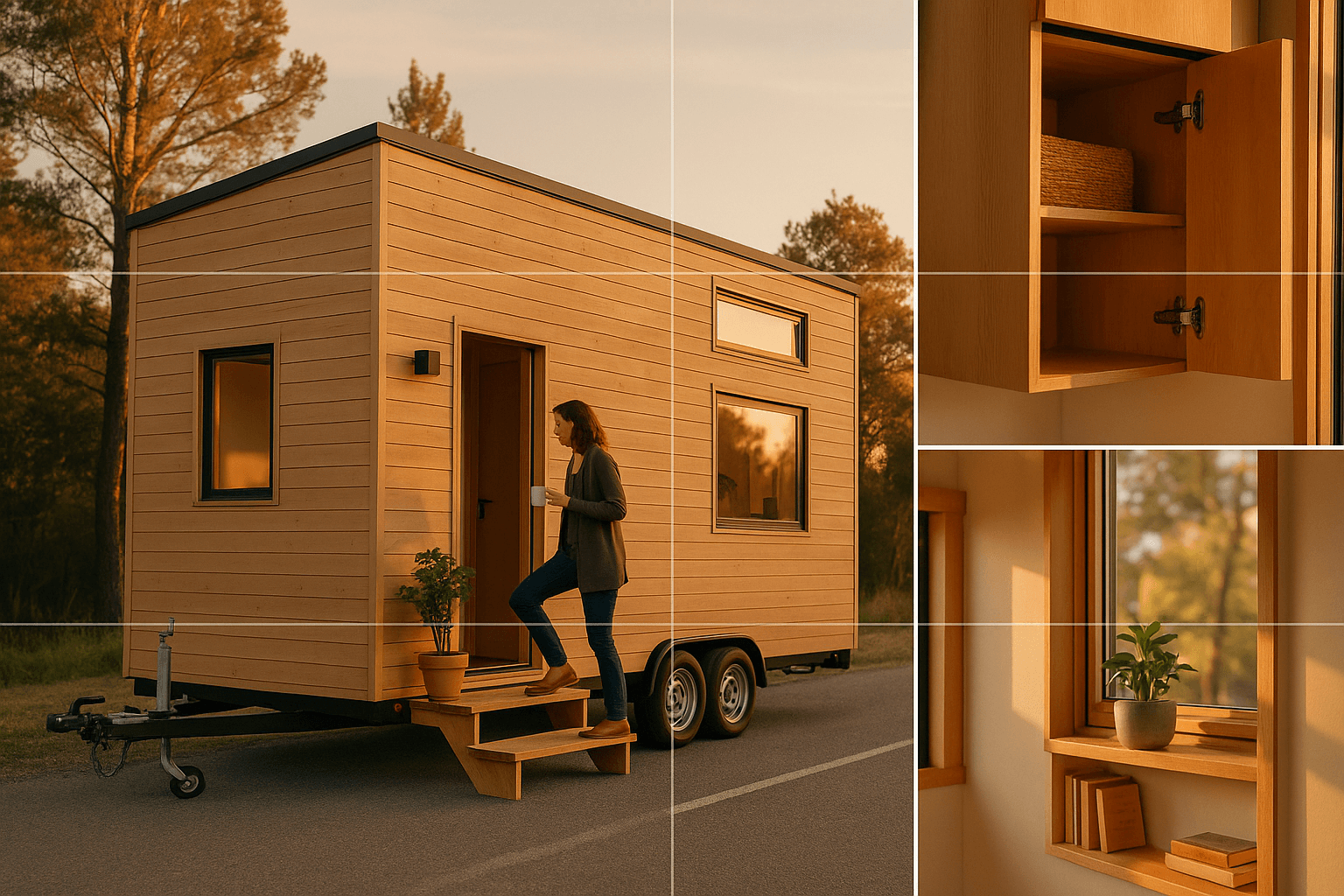
Road-legal tiny house design comes down to one idea: you're not just designing a home—you're designing a load that must fit inside a very specific width + height + length + weight envelope. In most places, builders aim for 8 ft 6 in (2.59 m) wide, ~13 ft 6 in (4.11 m) tall, and a trailer length in the 16–30 ft range, while keeping the fully-loaded weight safely under the trailer's GVWR/axle ratings. The fastest way to stay within those limits is to design constraint-first—and that's exactly how we approach it at TinyHouses.
Important: exact "legal" limits vary by country/state/province, and sometimes by road type. Always verify local rules for maximum dimensions, lighting/brakes, permits, and tow-vehicle requirements.
Common road-legal targets (the envelope most tiny houses are designed to fit)
These are the typical planning targets that keep many Tiny House on Wheels (THOW) moves "simple" (often meaning fewer permits, fewer route restrictions, fewer surprises).
Width: the make-or-break number for "no-permit" moves
Common target: 8 ft 6 in (102 in / ~2.59 m) overall width in many regions (especially North America).
What counts toward overall width (easy-to-miss):
- Exterior cladding and trim
- Corner boards
- Light fixtures that stick out
- Fold-down decks/railings (if they don't fold within the width)
- Some awning hardware
Design reality: your interior width is smaller. Even if you design to 8'6" overall, usable interior width shrinks after:
- Wall framing (2×4 or 2×6)
- Insulation and service cavity (sometimes)
- Interior wall finish
- Exterior sheathing + rainscreen + cladding
Typical usable interior width range: roughly ~7'6"–8'0" depending on your wall build-up.
How TinyHouses helps: In our AI Designer you can start with a road-legal width target (like 8'6") and generate layouts that respect the boundary—then tweak wall thickness, cabinetry depth, and stair placement without accidentally "spending" inches you don't have.
Height: the constraint people blow by accident
Common planning cap: ~13 ft 6 in (4.11 m) overall height (ground to the highest point). This is a widely used "safe planning" number because of bridges, power lines, and route restrictions—but it varies.
Why height is tricky: your house height is a stack-up of multiple layers:
- Trailer deck height (varies a lot)
- Floor system thickness
- Ceiling/roof structure
- Roof pitch (gable roofs cost height faster)
- Loft framing + finish
- Rooftop items (the sneaky part)
Common rooftop 'gotchas' that add inches:
- Solar panels on tilted mounts
- Mini-split line hide channels or roof penetrations
- Skylight curbs
- Chimney caps
- Roof racks, deck rails, vent cowls
How TinyHouses helps: When you design with our AI templates (e.g., 20', 24', 28'), you can choose a roof type (shed vs gable) and see how it affects loft comfort while staying inside a height target. It's a practical way to explore "Do I want a more tow-friendly shed roof, or a taller gable for a nicer loft?" before you commit.
Length: trailer length vs overall length (and why 20–28 ft is a sweet spot)
You'll hear trailer lengths commonly discussed around 16–30 ft.
Practical livability vs towing:
- 16–20 ft: nimble and lighter; storage and seating become design-critical
- 20–28 ft: often the best balance for full-time comfort and towing practicality
- 28–30 ft: more spacious, but turning radius, axle load, and tow vehicle demands grow quickly
Two different length numbers matter:
- Trailer length (the deck)
- Overall length (truck + trailer, plus any rear overhang/bump-outs)
Design implication: rear overhangs, porches, and bumper storage can hurt turning clearance and sometimes affect legality.
How TinyHouses helps: Our marketplace filters make it easy to browse by trailer length and compare layouts that are already designed for towing reality—so you're not guessing whether 28' feels right for your lifestyle.
When permits generally apply (high-level)
Oversize rules differ, but permits are commonly triggered when you exceed standard width/height/length.
What oversize can involve:
- Oversize permits
- Approved routes (or prohibited roads)
- Travel time windows (daylight only, weekdays only, etc.)
- Escort vehicles at higher thresholds
The practical takeaway: Many people design to "permit-free width," then accidentally exceed limits with height (roof gear) or weight (fully loaded).
Weight: the limit that ends more builds than width
If you want a towable tiny house, treat weight like a design material—because you can run out of it.
The four ratings you must understand
| Term | What it means | Why it matters in design |
|---|---|---|
| GVWR | Max trailer weight when loaded | Your finished house + water + gear must stay under this |
| GAWR | Max weight each axle can carry | A heavy kitchen can overload an axle even if GVWR seems fine |
| Tongue weight | Load pressing down on the hitch | Stability often improves when properly balanced |
| Payload | GVWR − empty trailer weight | The real "budget" you have for the entire house |
Tongue weight rule of thumb: many towing setups target ~10–15% of loaded trailer weight on the hitch for stability (always confirm with your trailer/tow vehicle manufacturer).
Typical trailer GVWR context (not a recommendation)
Tiny-house trailers often fall somewhere around 10,000–21,000 lb GVWR, depending on axle count and rating (e.g., 2×5,200 lb; 2×7,000 lb; 3-axle setups). Your usable payload can be much less after the trailer's own weight.
Water and batteries: "small systems" that weigh a lot
- Water weighs about 8.3 lb/gal (~1 kg/L).
- Example: 50 gallons adds ~415 lb—before the tank, plumbing, and supports.
- Battery banks (especially large off-grid setups) add significant weight.
Design implication: If you want off-grid capability, you have to plan where that mass goes—and how much payload it consumes.
How TinyHouses helps: When you design on TinyHouses, you can plan around real-life systems (tanks, batteries, appliances) early—before they become last-minute add-ons that push you past GVWR or make the house tow poorly.
Weight distribution: where you place pounds matters as much as how many
A stable tiny house isn't just "under GVWR." It's balanced.
A simple placement rule: heavy + low + near the axles
Place the heaviest items:
- Low (reduces sway)
- Near the axle line (reduces extreme tongue/heavy-tail problems)
Best candidates to keep low/central:
- Water tanks
- Batteries/inverter
- Washer/dryer (if any)
- Tool/gear storage
- Large appliances
Loft weight changes towing behavior
Lofts are amazing for space, but storing heavy items up high (books, water jugs, dense furniture) increases the center of gravity and can make sway more likely.
TinyHouses workflow tip: We recommend designing "heavy zones" first (kitchen, tanks, batteries), then letting AI generate layouts around those constraints—because moving a kitchen 2 feet can be the difference between stable towing and constant correction.
Designing within the envelope (the repeatable method)
Instead of guessing, design like you're managing four budgets: width, height, length, weight.
1) Pick a trailer type that supports your height goal
Between-the-wheels trailers often allow a lower floor height (wheels outside the interior), which can help you stay under a height target.
Deck-over trailers can give you a flat deck width, but often sit higher, which can eat into your height budget.
Design trade-off: lower floor height can make lofts easier; higher decks may simplify certain structural layouts but can push overall height faster.
How TinyHouses helps: Start your design from a known trailer size (18', 20', 24', 28') and choose a roof style that keeps the overall height manageable. You can quickly generate multiple options and compare.
2) Build a height "stack-up" before you fall in love with a loft
Do this early:
- Measure/estimate from ground → trailer deck → finished floor → ceiling → roof → highest rooftop element
- Decide whether your loft needs sit-up height, stand-up height at the stair landing, or just sleeping clearance
Design trade-off examples:
- Shed roof: often more height-efficient; can still give a comfortable loft if planned well
- Gable roof: can feel spacious inside; may cost precious exterior height quickly
3) Spend width like a minimalist (because you are)
At 8'6" overall, every inch matters.
Practical width-saving moves:
- Keep circulation paths clear with shallower cabinetry where possible
- Use pocket doors or sliding doors
- Choose integrated seating/storage instead of bulky furniture
- Consider compact stair designs (with safety in mind)
TinyHouses advantage: Our AI designs can generate multiple stair styles (storage stairs vs alternating tread vs ladder concepts) within the same width target so you can pick what matches your family's comfort level.
4) Choose materials that feel premium without the weight penalty
Weight blowouts often come from "normal house" finishes.
Common heavy offenders:
- Tile showers with thick backer systems
- Stone countertops
- Heavy plaster finishes
- Excessive large-pane glass
Lighter-feeling alternatives (often still modern and durable):
- Lightweight wall panels in wet areas
- Butcher block or lightweight composite counters
- Smart storage millwork instead of masonry-like built-ins
How TinyHouses helps: When you explore designs and listings, you can compare build styles that prioritize towability—so you're not forced into a heavy finish package to get a beautiful modern interior.
Oversize "gotchas" checklist (what makes a legal design accidentally illegal)
Before you finalize a design, check for anything that extends beyond your envelope.
Width gotchas:
- Exterior lights protruding past trim
- Fold-down decks/porches that don't lock within width
- Awning arms
Height gotchas:
- Solar mounts that tilt
- Chimney caps and weather hats
- Roof racks or roof decks
- Skylight curbs
- A/C units or rooftop ventilation
Length/overhang gotchas:
- Rear storage boxes
- Spare tire mounts
- Extended bumpers
- Long tongue boxes
TinyHouses tip: When browsing the marketplace, look for listings that specify overall dimensions and towing setup. Those are usually the homes whose builders designed for real-world transport, not just interior photos.
A simple "Road-Legal Envelope + Weight Budget" worksheet (copy/paste)
Use this as your first design pass. It keeps you honest.
Step 1: Set your target envelope
| Constraint | Your target | Notes |
|---|---|---|
| Overall width | 8'6" (2.59 m) typical target | Verify local rules |
| Overall height | ~13'6" (4.11 m) common planning cap | Verify route/region |
| Trailer length | 16–30 ft common | Pick based on lifestyle |
| GVWR | (from trailer spec) | Your absolute max |
Step 2: Build a weight budget (high level)
| Category | Estimate | Notes |
|---|---|---|
| Trailer (empty) | From manufacturer | |
| Framing + sheathing | ||
| Insulation + interior walls | ||
| Windows + exterior doors | Big swing factor | |
| Roofing | ||
| Cabinetry + built-ins | Often heavier than expected | |
| Appliances | Include fridge/oven/water heater | |
| Electrical (incl. batteries) | Batteries add fast | |
| Plumbing (incl. tanks) | Water is 8.3 lb/gal | |
| Heating/cooling | Placement affects height | |
| Furniture + personal gear | Don't ignore this | |
| Total loaded | Must be under GVWR |
Step 3: Decide heavy-item placement
- Batteries: low + near axles
- Water tank(s): low + near axles
- Kitchen: avoid extreme front or extreme rear weight bias
If you want, you can turn this worksheet into your TinyHouses AI prompt so the generated layouts start with your real constraints.
TinyHouses: design inside the limits, then shop tow-ready options
Most "dimension guides" stop at numbers. We built TinyHouses to help you design within the numbers.
Use AI templates built around typical trailer sizes
Inside our AI Designer you can:
- Start from common trailer lengths (like 18', 20', 24', 28') and a road-legal width target
- Generate floor plans that respect realistic circulation and furniture sizes
- Iterate roof styles and loft concepts while keeping an eye on the height budget
Browse the marketplace for models already optimized for towing
When you're not ready to design from scratch, you can explore tiny houses worldwide and filter for:
- Trailer length
- Loft count
- Stair type
- Off-grid features (solar, tanks, batteries)
That means you can learn what works by comparing real towable homes—then design your own version with clearer constraints.
Design to the strictest constraint (and treat weight like engineering)
To stay road-legal, most tiny houses on trailers are designed to a common envelope—8'6" wide, ~13'6" tall, and a trailer length that matches your tow setup—but weight and balance are what decide whether the home moves safely. If you treat width/height/length/weight as budgets from day one, you'll avoid the classic "beautiful house that can't move" problem.
Start designing within real towing limits: Our AI generator lets you set width, height, length, and system placement constraints before generating floor plans. Try it at TinyHouses.
FAQ: Tiny house on wheels road-legal dimensions
What's the maximum tiny house width I can tow without a permit?
In many places, builders aim for 8 ft 6 in (102 in / ~2.59 m) as a common "no-permit" width target. Exact rules vary—confirm locally.
How tall can a tiny house on a trailer be?
A common planning target is ~13 ft 6 in (4.11 m) overall height to reduce route issues, but legal and practical limits vary. Measure from the ground to the highest fixed point.
Is 28 ft or 30 ft too long to tow safely?
Not necessarily, but longer builds tend to increase weight, turning radius challenges, and tow-vehicle demands. Many people find 20–28 ft a comfortable balance between livability and towing practicality.
How much does a typical tiny house on wheels weigh?
It varies widely based on size and materials. The key is to design to your trailer's GVWR and axle ratings rather than guessing. Heavy finishes and large off-grid systems can push weight up quickly.
What's the difference between GVWR, GAWR, payload, and tongue weight?
- GVWR: max loaded trailer weight
- GAWR: max load per axle
- Payload: GVWR minus empty trailer weight
- Tongue weight: weight carried by the hitch
How do I avoid sway and balance problems?
Plan heavy components low and near the axles (batteries, tanks, appliances). Avoid loading dense items high in lofts. Confirm tongue weight and tow ratings with your trailer and vehicle manufacturer.
Can I build bump-outs over the fenders and still be road-legal?
Sometimes—depending on local rules and how overall width is measured. Bump-outs can also affect weight distribution and turning clearance. Always check your local regulations.
Do solar panels or mini-splits make a tiny house too tall?
They can. The "gotcha" is mounts, curbs, caps, and clearances—not just the panel thickness. Design rooftop systems early so you don't exceed your height target.
When do I need oversize permits or escorts?
Generally when you exceed standard width/height/length thresholds. Some regions also restrict travel times and routes. Always confirm requirements before moving.