Living Tiny With Kids: Smart Layouts, Storage Systems, and Daily Routines That Actually Work
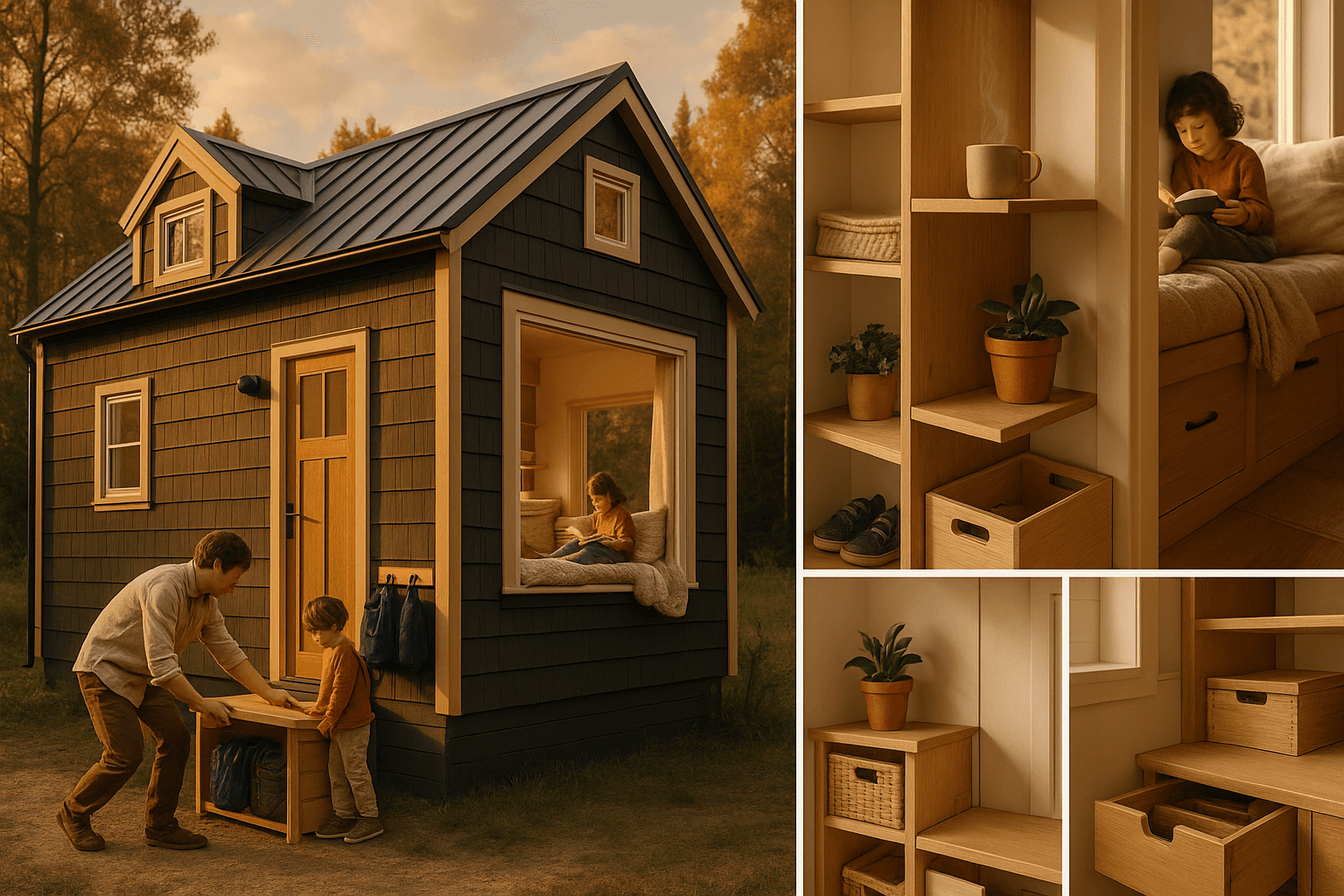
Families thrive in tiny houses by designing for low-friction daily flow—two sleeping zones, a real entry "mud zone," kid-proof storage that resets easily, and routines that replace extra rooms. With TinyHouses AI, you can generate family-ready layouts (bunks, safer stairs, pocket-door micro-rooms, school nooks) in minutes, then match your design to rentals or homes for sale worldwide—no more guessing what will work with your kids.
The real challenge isn't square footage—it's friction
Tiny living with kids usually breaks down in predictable places:
- Noise + privacy: everyone's always "in the same room"
- Stuff flow: backpacks, shoes, wet gear, toys, laundry everywhere
- Schedule collisions: bathroom rush, remote school calls, naps
The fix follows a simple pattern:
Constraint → Design choice → Routine
Example: No hallway closet → entry bench + hooks → one shoe bin per person → 60‑second exits.
TinyHouses helps you prototype these decisions in minutes with AI (instead of discovering problems after you move in), then browse listings that already match your family's needs.
Start with your family profile
Before you design—or pick a model—get specific. In tiny homes, vague goals create daily stress.
Family constraints checklist
- Family size + kids' ages: toddlers vs teens need different privacy and sleep safety
- Sleep priorities: early risers, light sleepers, naps, snoring
- School style: homeschool, remote school, local school with homework space
- Climate: wet winters demand mud zones; hot climates need shade + ventilation
- Outdoor access: porch, yard, nearby park/trail
- Cooking intensity: real cooking needs real counter space
- Sensory needs: noise sensitivity, ADHD routines, predictable "calm corners"
How TinyHouses helps: Input these as constraints in our AI generator. Tell it what you refuse to compromise on ("two sleep zones + washer + porch big enough for school table"). You'll get layouts that match your reality—not generic tiny floor plans.
Family-friendly sizes that actually work
Most tiny homes range 100–400 sq ft. Family-friendly options often stretch to 300–600 sq ft (including park models/ADUs).
- 100–250 sq ft: doable with kids short-term, but you'll rely heavily on outdoor "extra rooms"
- 250–400 sq ft: where many families of 3–4 succeed with strong zones + storage discipline
- 400–600 sq ft: more forgiving—often allows a micro-second room, bigger kitchen, calmer school setup
In our marketplace, filter by size and features (two sleep zones, porch, laundry) to compare what each size band actually delivers in family function.
Three layouts that work for families
A calm family tiny house usually has two things:
- Two sleeping zones (even if one is a nook)
- A "mess buffer" at entry (mudroom energy)
Below are three proven patterns we generate and refine with TinyHouses AI—then match to real listings.
Layout A: Main-floor bunk nook (ages 3–10)
What it is: Built-in bunks or bunk alcove on main floor (often with curtain/pocket door), parents in loft or main bedroom.
Why it works:
- Kids get "room feel" without needing full bedroom
- Naps and bedtime happen while adults still use the house
Design details for TinyHouses AI:
- Built-in bunks with integrated drawers under lower bunk
- Reading lights per bunk (reduces bedtime chaos)
- Curtain or pocket door for visual boundaries
- "One shelf per child" for treasures/books
Layout B: Kids in loft, parents main floor (older kids)
What it is: Kids sleep in loft, parents have main-floor bed (often micro-room).
Why it works:
- Parents get easier night bathroom access
- Older kids like the loft "den" feeling
Loft safety realities:
- Cute ladders become nightly hazards when kids are sleepy
- Prefer stairs with handholds over steep ladders
- Strong guardrails (robust height, no climbable gaps)
- Night path to bathroom (motion light + clear floor)
TinyHouses advantage: Generate versions with ladder vs. stairs, compare tradeoffs (storage vs. footprint) before committing.
Layout C: Micro-second room/flex space (the "sanity saver")
What it is: Tiny enclosed room (pocket door) that rotates between office, sick-day room, quiet corner, guest room.
Why it works: Privacy is behavior management in tiny homes. Even one closable space changes everything.
Must-haves:
- Pocket door (saves space)
- Ventilation + power outlets
- Fold-down desk or daybed
Privacy and noise: the #1 sanity variables
In small spaces, conflict comes from feeling watched or interrupted.
Quick privacy wins
- Curtains as "soft doors" for bunks and loft openings
- Pocket doors for bathrooms and micro-rooms
- Visual boundaries: half-walls, shelving dividers, bed curtains
Acoustic control that works with kids
- Rugs/soft mats in play zones
- Fabric panels or thick curtains (especially around sleeping nooks)
- Door sweeps on bathroom doors
- "Headphones live here" station near school area
TinyHouses tip: Tell our AI "reduce noise transfer" and it prioritizes layouts separating sleep from loud zones (kitchen/play) with soft-boundary solutions.
Storage for kid stuff: bins, not closets
Families don't just own more—they cycle more: sizes change, seasons rotate, school supplies come and go.
The rule that works: measure in bins
Instead of "more storage," use fixed containers per category:
- Toys: 1 bin per type (blocks, dolls, cars, art)
- Clothes: 1 drawer per child + 1 seasonal tote per child
- Sports/outdoor: 1 gear bin per person
- Paper/school: 1 "inbox" tray per child
When the bin fills up, something leaves. That's how tiny stays stable.
Toy rotation (keeps floors clear)
Realistic rotation:
- Keep 6–10 toys/sets accessible
- Store rest in lidded totes (out of sight)
- Swap weekly or every two weeks
Gift-proof version:
- "New toy in → old toy to rotation tote"
- Birthday/holiday: one "incoming" bin prevents permanent clutter
With TinyHouses AI: Ask for "toy rotation storage" and get under-bench drawers, stair storage, and dedicated tote bays sized to your family.
The "tiny campus": outdoor rooms
Families who thrive treat the home as part of a small system:
- Porch = living room/classroom extension
- Shed = gear + seasonal storage
- Entry pad = mud zone
- Yard/picnic table = art + messy play
Outdoor extensions that change daily life
- Covered porch sized for small table (school/art) + storage trunk + two chairs
- Outdoor rinse station (mud, sand, dog)
- Weatherproof toy chest (big, simple, fast cleanup)
Rain/snow climates: Prioritize covered entry + boot-dry strategy (mat + hooks + airflow). Less about prettiness, more about keeping interior calm.
TinyHouses advantage: Generate plans with porches deep enough for actual tables, then search marketplace listings with porches, decks, or shed compatibility.
School and play in 300–600 sq ft
School (remote or homeschool) becomes the schedule anchor. The house must support it on hard days.
Non-negotiables for remote/homeschool
- Stable internet (or space for strong router/Starlink)
- 1–2 dedicated work surfaces
- Device charging that doesn't sprawl
- Lighting that doesn't cause fatigue
- Quiet-ish zone for calls
Layout ideas that work
- Fold-down desk bar along wall (with cable management)
- Two-seat dining table that becomes school by schedule
- Charging locker: one cubby per person, cords contained
- Backdrop control: curtain behind call seat for visual calm
Scheduling rules
- "One call at a time" rule (others move to porch/quiet corner)
- "Two-activity rule:" one loud activity (music, building), one quiet (reading, drawing)
TinyHouses helps: Design two versions—school at table vs. built-in fold-down bar—see which keeps circulation open and charging contained.
Daily routines that protect sanity
Tiny houses don't forgive vague habits. The goal: resettable systems.
Morning flow (tiny houses need choreography)
Create simple order of operations:
- Bathroom sequence (who goes first)
- Breakfast zone stays clear (one prep person)
- "Launch pad" by door
Reliable launch pad:
- Hooks at kid height
- One backpack spot per child
- One shoe bin per person
- Small tray for keys/wallet
The 10-minute daily reset
Same time every day (after dinner works well):
- Toys → bins
- Dishes → done
- Surfaces → cleared
- Tomorrow's clothes → set
Weekly reset (prevents slow creep)
- Swap toy rotation
- Restock school supplies
- Rotate seasonal clothing/gear
- Quick donation box check
TinyHouses advantage: Ask AI for "reset zone" (bench, cabinet, or tote bay near entry) so your routine has a physical home.
Laundry, mud, and gear: the chaos trio
These create most "we can't do this" moments.
Laundry solutions
- If possible: compact washer/dryer or combo unit
- If not: defined hamper system (1 per person or 1 lights/1 darks)
- Drying: retractable line or foldable rack with consistent storage spot
Mud and wet gear
- Boot tray
- Hooks (more than you think)
- Towel hook for wet jackets
- One outdoor bin for "too dirty to enter" items
TinyHouses helps: Filter marketplace for washer/dryer, use AI to design entry bench + hook wall sized for your family count.
Safety essentials with kids
Family tiny living is only fun when it's safe.
Loft and stairs safety
- Prefer stairs with railings over ladders for many families
- Strong guardrails; avoid large gaps
- Night lighting to reduce falls
Kitchen safety (tiny kitchens are high-contact)
- Consider induction cooktop (cooler surface) if available
- Lockable storage for cleaners/tools
- Pot handles turned inward + defined "kid-free zone" during cooking
Fire and egress plan
- Working smoke/CO alarms
- Fire extinguisher location everyone knows
- Clear exit paths (no storage in escape route)
- If loft sleeping: safe exit plan for your build and local code
TinyHouses safety advantage: Our AI designs incorporate kid-safe stairs, gate points, and clear circulation so safety isn't an afterthought.
Legal and stability (families need this more)
Rules vary widely:
- Zoning/placement (local code)
- THOW often classified as RV, impacting full-time living
- School district address and mail stability
- Insurance and inspections (RV/ANSI vs. IRC vs. ADU rules)
Why it matters: Kids thrive on stability—address, school logistics, compliance reduce stress.
TinyHouses advantage: Browse global options aligned with your intended use (full-time vs seasonal, wheels vs fixed), then refine design to match what's realistically placeable.
Design your layout before you commit
The fastest way to avoid expensive mistakes: test multiple family layouts against your daily life.
Three sample TinyHouses AI prompts
Family of 4, young kids: "Design a 380–450 sq ft tiny house for 2 adults + 2 kids (ages 4 and 7). Main-floor bunk nook with curtain, stairs (no ladder), entry mud bench with 4 hooks + 4 shoe bins, fold-down school bar for two laptops, toy rotation tote bay, covered porch for table."
Family of 3, remote school + quiet work: "Design a 320–400 sq ft tiny home for 1 adult + 2 kids (ages 9 and 12). Add pocket-door micro-room for office/sick room, kids sleep loft with safe stairs, acoustic separation from kitchen, charging cubbies for 3 devices, small outdoor storage."
Family of 5, outdoor-forward: "Design a 500–600 sq ft park-model tiny house for 2 adults + 3 kids (ages 2, 6, 10). Two sleeping zones, bathtub option, washer/dryer, big mudroom entry, porch classroom area, gear lockers, storage sized by bins."
Then match design to real listings
Use your AI-generated must-haves to screen rentals and purchases:
- Square footage band (300–600 sq ft for family comfort)
- Two sleeping zones
- Washer/dryer
- Porch/deck + outdoor storage
- Kid-safe stairs/loft
- Internet viability for school/work
This is the core TinyHouses advantage: design → compare → rent/try → buy, all in one place.
Ready to design your family-friendly tiny house? Use TinyHouses AI to generate layouts that work for your kids' ages, school needs, and daily routines—then find real listings that match. Start designing: tinyhouses.to/design