Start the Tiny House Lifestyle Before You Buy: A Smart Test Plan
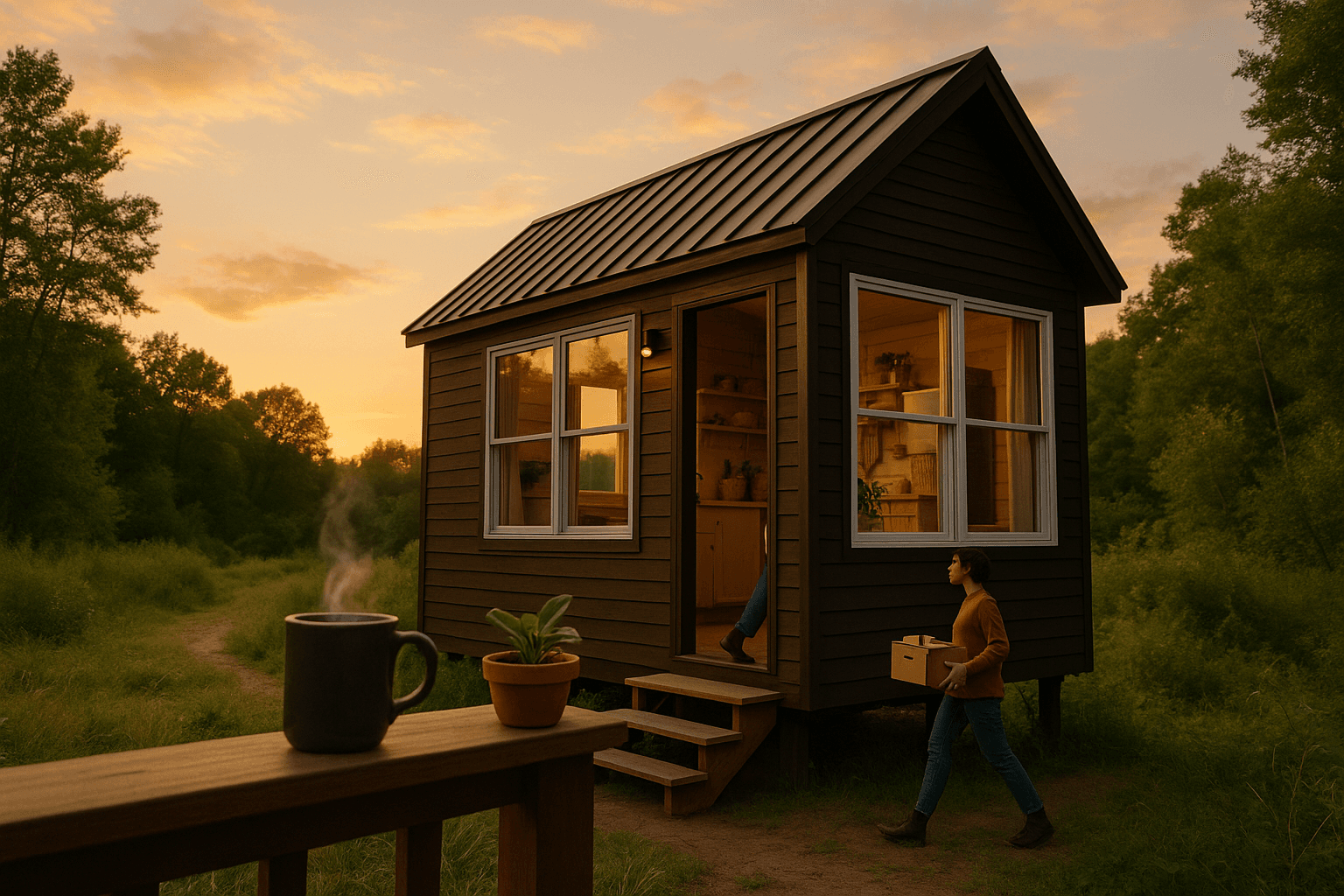
Want to live tiny but not ready to commit? Smart. You can start the tiny house lifestyle without buying by running a phased "try-before-you-buy" plan: prep your stuff, do short stays (2–14 nights) to learn what breaks, then rent for 30–90 days to build real systems—while designing your future tiny home with AI based on what you actually learn.
Think like a designer: test, learn, iterate
Tiny houses are typically 200–300 sq ft. That size is totally livable—but unforgiving. In a compact home, every decision shows up fast:
If an item doesn't have a defined "home," it becomes clutter—immediately.
So instead of debating tiny living in theory, we recommend a modern approach:
- Design a first draft of what you think you need (use our AI designer for this)
- Test-drive real tiny homes through rentals in different layouts
- Log friction → adjust the design (Version 0 → Version 1 → Version 2)
- Rent longer only when you've earned clarity
TinyHouses is built for that exact journey: design with AI, then rent or buy from our global marketplace once you know what actually fits your life.
Phase 1 (7–21 days): Prep — declutter with purpose
This phase makes everything else cheaper, easier, and more honest. Skip it, and your trial will feel cramped for the wrong reasons.
Define your 5 non-negotiables
Before you book anything, decide what must be true for tiny living to work.
Examples (choose your five):
- Sleep comfort (loft OK vs main-floor bed)
- Bathroom privacy (wet bath vs dry bath, ventilation)
- Work-from-home needs (desk space, Wi‑Fi, quiet zones)
- Cooking style (counter space, full oven vs cooktop)
- Pets/kids (floor space, safe stairs, mud cleanup)
- Accessibility (no ladder, wider pathways)
How TinyHouses helps: Use our AI design generator to create a "Version 0" concept based on your non-negotiables—so you're testing layouts strategically, not randomly.
Hit a realistic "move-in-ready" target
Tiny living gets dramatically easier when your stuff shrinks to a predictable size.
Aim for one of these:
- Target A: belongings fit into 1–2 small closets + 6–10 labeled bins
- Target B: a one-car-load goal for what you'd bring into a 200–300 sq ft home
Simple sorting that works:
- Keep (Tiny-Ready): you'd use it weekly in a small home
- Bridge Storage (90 days): you're unsure; test it later
- Sell/Donate: duplicates, "someday" items, bulky rarely-used gear
Use storage as a bridge—not a life sentence
Storage units can quietly erase the financial benefits of going tiny. Use storage as a time-limited bridge with a 90-day review date. If you haven't retrieved something in 90 days, it's a strong signal to sell or donate.
Build your "Tiny Kit"
Bring a lightweight kit that mirrors how you'd live long-term:
- Compact cooking set (one pan, one pot, chef's knife, cutting board)
- Laundry system (one bag, detergent sheets, clothesline)
- Multi-use basics (layered clothing, quick-dry towels)
- Work kit (laptop stand, headphones, power strip)
How TinyHouses helps: When you generate your AI concept, design around your kit: where does laundry live? Where do coats dry? Where does the laptop land daily? That's how tiny homes become calm—not cramped.
Phase 2 (2–14 nights): Test constraints in different layouts
This is where you learn the "space math" quickly. Most tiny homes comfortably seat 2–4 people, and the biggest variables are:
- Loft headroom + access (ladder vs stairs; stairs take floor space)
- Kitchen workflow (counter length, sink size, pantry)
- Bathroom type (wet bath vs dry bath; condensation management)
What to book
Try two different tiny houses rather than one longer stay:
- Stay #1: loft sleeping (ladder or stairs)
- Stay #2: main-floor sleeping (or lower loft with better headroom)
If possible, vary one more factor:
- Urban edge vs nature location
- Off-grid vs full hookups
- Cold/wet climate vs warm/dry climate
How TinyHouses helps: Browse and rent tiny homes worldwide by the specific layout features you're testing (sleeping style, bath type, work area), so your experiments aren't random.
Start a "friction log"
Every day, write 3 bullets:
- What felt easy?
- What felt annoying?
- What did you wish existed (a shelf, a hook, bigger counter, a door)?
At week's end, summarize:
- Your Top 5 annoyances (ranked)
- Mark each as:
- Design-fixable (layout/storage/bed type)
- Location-fixable (noise, weather, isolation)
- Habit-fixable (overpacking, messy kitchen)
How TinyHouses helps: After each stay, update your AI design with the friction log: "Need stairs not ladder," "Add mudroom cabinet," "More counter space." Your design evolves based on evidence.
Phase 3 (30–90 days): Build routines that survive real life
A month is long enough to expose the difference between "cute weekend" and "I can live like this." Test:
- Groceries + meal prep rhythm
- Laundry frequency and friction
- Mail and deliveries
- Exercise and hobbies
- Hosting (even just one friend visiting)
What success looks like
You're aiming for a calm baseline:
- Mornings don't feel cramped
- The kitchen stays usable
- You can work without constantly relocating
- Your stuff returns to its "home" without effort
Decision checkpoint: Is the pain fixable?
Use your friction log from weeks 2–4 and decide:
- Design-fixable: "Need a dedicated desk," "Need stairs with storage"
- Location-fixable: "Too noisy," "No community," "Too far from groceries"
- Lifestyle-fixable: "I own too much," "I need outdoor time daily"
How TinyHouses helps: Take your checkpoint conclusions and generate Version 1 of your tiny house using our AI designer, then cross-check that design against listings you can rent next.
Phase 4 (3–12 months): Test seasonality and community
If Phase 3 proved "tiny can work," Phase 4 answers: "Will it still work in a different season?"
Key things that only show up over time:
- Heating/cooling comfort (and costs)
- Condensation + moisture management
- Mud management (where wet gear goes)
- Maintenance rhythms (filters, propane, small repairs)
- Social fit (grounded or isolated?)
Choose your best-fit trifecta
At the end of a long-term rental, you should name:
- Layout: loft vs no-loft, wet vs dry bath, storage type, kitchen style
- Location: climate, nature access, distance to town, community vibe
- Daily routine: work pattern, outdoor living, cooking habits, gear load
How TinyHouses helps: Our global marketplace lets you test different regions and climates without committing to one "forever location" too early—then refine your AI design to match where you actually want to live.
Design your future home while you test
The fastest path to a great tiny home isn't guessing—it's iteration.
Here's the TinyHouses method:
- Generate Version 0 (based on your current life)
- Rent a tiny house that matches 70% of it
- Update your design with what you learned
- Generate Version 1 / Version 2 / Version 3
Post-stay design questions
After every stay, answer:
- What did I do daily that had no "home"?
- Which area created the most congestion (kitchen, entry, bath, loft)?
- Did I feel comfortable hosting even one person?
- What did I avoid doing because the space made it annoying?
- What would I trade for more comfort (bigger counter vs shower vs storage)?
How TinyHouses helps: Our AI designer turns those answers into a concrete layout you can visualize—then validate through rentals—until you're truly ready to buy.
Your roadmap at a glance
| Phase | Time | Goal | Your Output | How TinyHouses Fits |
|---|---|---|---|---|
| 1: Prep | 7–21 days | Reduce friction before you trial | 5 non-negotiables + declutter target | Create Version 0 with AI |
| 2: Micro-trials | 2–14 nights | Learn layout constraints fast | Friction log + top 5 annoyances | Rent different layouts to compare |
| 3: Medium trial | 30–90 days | Build routines | Design/location/lifestyle fixes | Update to Version 1 |
| 4: Long-term | 3–12 months | Seasonality + community fit | Layout+location+routine clarity | Test regions globally |
Start designing your tiny future
Don't wait until you're "ready to buy" to start designing. The best tiny homes come from real experience, not guesswork.
Create your first AI-generated design based on your non-negotiables, then use our global rental marketplace to test it in the real world. Each stay makes your next design smarter.
Design with AI → Rent to test → Iterate → Repeat
That's how you end up with a tiny home that actually fits your life—not someone else's idea of what tiny living should be.