Roof Decks on Tiny Homes: The Glamour Feature That Can Ruin Your Build (Unless You Do This)
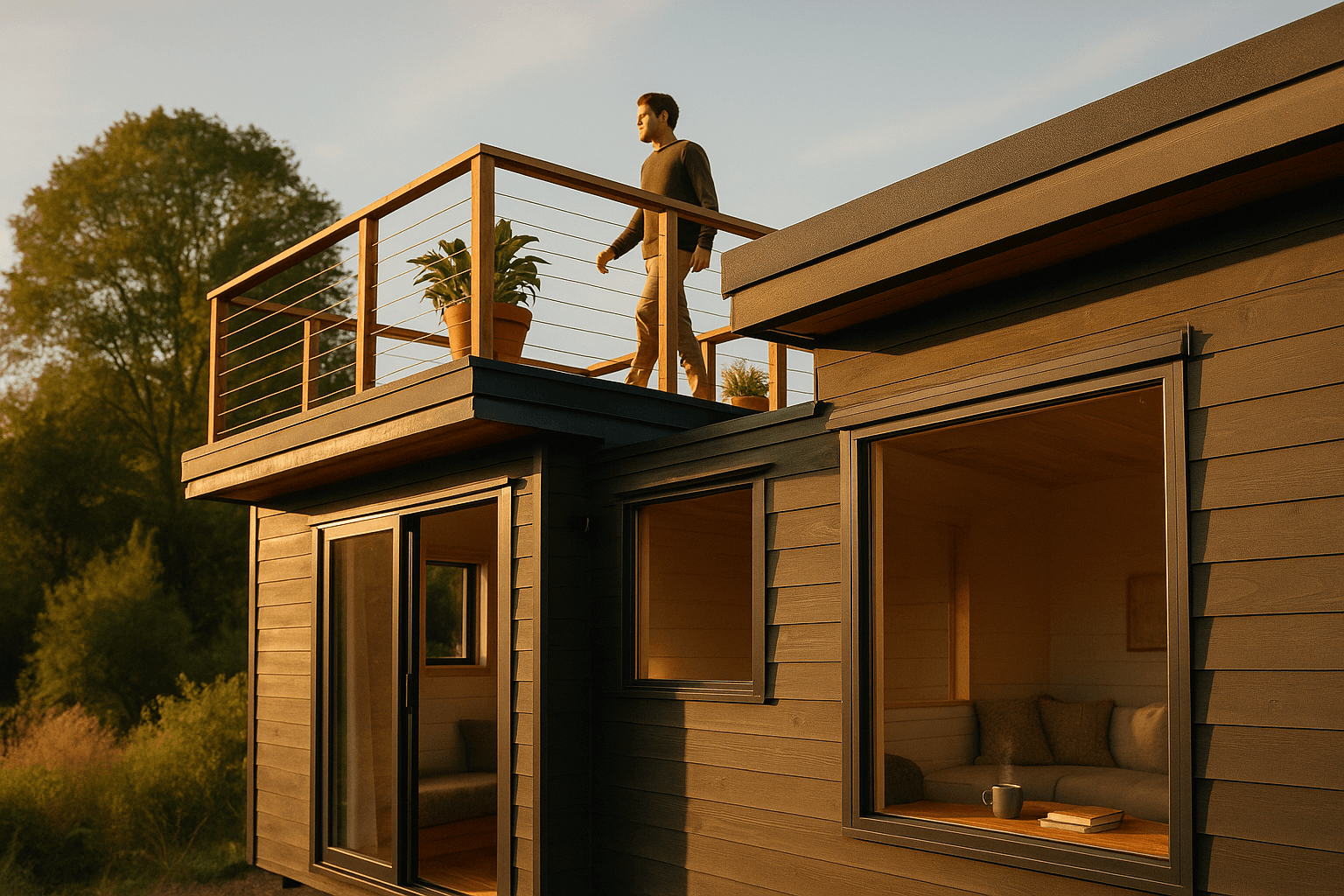
A roof deck can deliver that indoor-outdoor, nature-connected tiny house vibe—but it's also one of the fastest ways to create leaks, overheating, wind issues, and ongoing maintenance nightmares, especially on a Tiny House on Wheels (THOW).
The safe path? Treat it like a full roof-system engineering problem—drainage, waterproofing, thermal bridges, uplift, access, and towing constraints—or choose a "tiny-first" alternative that gives you the same feeling with far fewer failure points.
At TinyHouses, we see this pattern constantly: people fall in love with the rooftop-lounge aesthetic, then discover late that their climate, mobility plan, and maintenance tolerance don't match the risk. Our approach: design it first with AI, stress-test the idea, then rent or buy a model that's actually compatible with your life.
The real issue: you're turning a roof into a floor
A roof deck isn't a "feature." It's a roof assembly that must work as a walking surface.
That changes everything:
- More penetrations: guardrails, stairs, hatch curbs, lighting, maybe solar mounts
- More edge detailing: corners and perimeters are where wind uplift is strongest and where membranes fail first
- More wear: foot traffic, furniture legs, grit, standing water, freeze-thaw
- More consequences in a tiny home: small volumes show moisture damage and heat gain fast
TinyHouses design tip: In our AI designer, we treat roof decks as a "high-risk system." Select a roof deck, and we prompt for climate + wind + mobility + usage frequency, then recommend either (a) a roof deck spec that's realistic, or (b) an alternative that delivers the same indoor-outdoor feeling with fewer weak points.
The unsexy engineering checklist (where roof decks usually fail)
If you want the vibe without the nightmare, these are the failure points you must design around.
1) Waterproofing: a roof deck is a "flat roof in disguise"
Most roof decks function like low-slope roofs, and low-slope roofs only succeed when layering and detailing are near-perfect.
The simple layer concept (what you're building):
- Structure (roof deck/sheathing)
- Control layers (air/vapor strategy depends on assembly and climate)
- Insulation (often above-deck if you're trying to reduce condensation risk)
- Waterproof membrane (this is the true roof)
- Protection layer (board/mat to prevent punctures)
- Drainage layer (so water has somewhere to go)
- Walking surface (wood tiles, pavers, or decking on sleepers)
Non-negotiable idea: the walking surface must be sacrificial—it should take the abuse, not your membrane.
How TinyHouses helps: If you choose "roof deck" in our AI design flow, we generate a "roof-as-floor" assembly concept matched to your climate (hot/humid, cold, coastal wind, etc.) and flag risky combos like "wood sleeper deck + debris-trapping + heavy rainfall."
2) Drainage: slope + overflow, or you're gambling
Ponding water is the quiet killer.
- Even "flat" roofs should have slope (commonly 1/4" per foot (2%))
- You need a primary drainage path and a secondary overflow (like scuppers/overflow routes) so a clogged drain doesn't become a rooftop bathtub
- Tiny roofs clog easily (leaves, pollen, ice). On a deck, debris gets trapped by furniture, planters, and corners
TinyHouses design tip: Our AI prompts include "Who cleans the roof?" and "How often?" because a roof deck can be perfectly designed and still fail if it can't be inspected and cleared seasonally.
3) Penetrations: every fastener is a future leak (unless detailed)
Common penetration offenders:
- Guardrail posts
- Stair stringers / landing connections
- Hatch curb + hardware
- Lighting + outlets
- Awnings/pergolas (tempting to add after the fact)
Rule of thumb: if you're drilling through a membrane, you're creating a long-term liability unless you're using purpose-built stanchions/boots and proper flashing details.
What viral videos rarely show: surface-mounted guardrails screwed through the top are often the beginning of the end.
How TinyHouses helps: When you toggle guardrails on in our AI designer, we steer you toward non-penetrating rail strategies (when feasible) or engineered penetrations that are actually flashable—then you can use that spec when comparing builders in our marketplace.
4) Thermal bridging + condensation: tiny homes amplify comfort problems
Roof decks introduce new thermal weak points:
- Metal posts, stair frames, and fasteners can create thermal bridges
- Thermal bridges can create condensation inside, especially in cold climates
- In hot climates, decks can increase solar load and stress the membrane if heat gets trapped
What it feels like in real life: hot spots, cold corners, mysterious dampness, and mildew smells that appear "out of nowhere."
TinyHouses design tip: Our AI flow asks where you'll use the deck (daily lounge vs occasional viewpoint). If it's occasional, we often recommend alternatives that keep your roof assembly simpler—and your interior comfort more stable.
5) Wind uplift + racking: guardrails can act like sails
Wind is brutal on roof edges and corners—the same places membranes are most vulnerable.
- Guardrails increase turbulence and uplift
- In storms, rails/parapets can magnify pressure at edges
- On a THOW, towing vibration and flex can fatigue seams, flashing, and fasteners over time
TinyHouses reality check: If you plan to tow regularly and want a roof deck, our AI tool flags it as a high-risk combo—then suggests "tiny-first" options like fold-out decks that keep the roof intact.
6) Access: hatch ladders look cool; stairs live better
A roof deck is only as good as its access.
Hatch + ladder (viral favorite) — common issues:
- Fall risk (wet shoes, night use)
- Air leakage at the hatch
- Awkward to carry food, blankets, or a laptop
- Harder emergency egress planning
Stairs — common issues:
- Take precious footprint and headroom
- Can increase exterior protrusions
- May complicate towing clearances
TinyHouses design tip: In the AI designer, you can compare "hatch," "exterior stair," and "interior stair" layouts and immediately see what you lose (storage, loft access, kitchen wall length) before you commit.
7) THOW constraints: height, weight up high, and towing sanity
Even if something is technically legal, it may be practically miserable.
Roof decks can push you over comfortable towing reality because you add:
- Thicker roof build-up (tapered insulation, membrane, protection, deck)
- Guardrails
- Hatch curb
- More weight high, raising the center of gravity
TinyHouses marketplace advantage: If you're shopping THOW listings, we help you filter toward models that are already engineered around towing constraints (height/weight), instead of retrofitting a concept that becomes unstable or non-road-friendly.
Three safer "tiny-first" alternatives that keep the indoor-outdoor vibe
If your goal is nature-connected living, a roof deck is only one path—and often not the best one.
1) Covered porch module (the easiest way to add an outdoor room)
A covered porch delivers the feeling people want from roof decks: lounging, dining, listening to rain, morning coffee—without turning your roof into a floor.
Why it works:
- Keeps the primary roof simpler (fewer risky penetrations)
- Adds shade (reduces overheating)
- Creates an "outdoor living room" that's usable more days per year
TinyHouses advantage: Use our AI designer to size the porch for your lifestyle (stroller? dog? two chairs + table? outdoor storage?), then browse listings/builders that offer porch-forward models.
2) Fold-out / flip-down deck (best for THOW + "camp mode")
A fold-out deck creates outdoor square footage when you're parked—without compromising your roof membrane.
Why it works:
- Keeps waterproofing simpler
- Adds outdoor space at a safer height
- Great for mobility: deploy it at the lake, fold it for travel
TinyHouses advantage: In our AI tool, you can test fold-out deck placement (kitchen side vs living side), door swing, and how it interacts with your parking setup—then find compatible THOW builds in the marketplace.
3) Big view-window + exterior platform (nature connection with durability)
If what you really want is "I can see and feel nature from inside," a panoramic window + small exterior landing can outperform a roof deck.
Why it works:
- Fewer waterproofing complexities than a roof deck
- Strong indoor-outdoor connection through sightlines
- Exterior platform becomes a simple transition space (boots, plants, sitting step)
TinyHouses advantage: Our AI designer helps you choose window size and placement based on privacy, prevailing winds, sun path, and overheating risk—then you can shop for models that match that exact glazing-first approach.
Quick decision matrix: roof deck vs alternatives
Use this as a practical first filter:
| Your reality | Roof deck | Covered porch | Fold-out deck | View-window + platform |
|---|---|---|---|---|
| Heavy rain + leaves/debris | Risky | Strong | Strong | Strong |
| Snow/ice + freeze-thaw | Risky | Strong | Strong | Strong |
| High wind / coastal storms | Risky | Strong | Medium-Strong | Strong |
| Hot sun / overheating concern | Medium | Strong | Strong | Medium-Strong |
| THOW + frequent towing | High risk | Medium | Best | Strong |
| "I hate maintenance" | Poor fit | Best | Strong | Best |
| "I'll use it daily" | Only if engineered | Best | Strong | Strong |
| "It's just for the view sometimes" | Consider alternatives | Strong | Strong | Best |
How TinyHouses makes this actionable: In our AI designer, you input your location (rain/snow/wind), mobility (THOW vs foundation), and how often you'll use outdoor space—then get a recommendation that aligns with this matrix and your layout.
What to ask a builder before you commit
When you're browsing tiny homes on TinyHouses—or interviewing a builder—these questions quickly separate "viral concept" from "livable system."
Roof deck verification questions
- How is the membrane protected from traffic?
- What's the slope and where does water go?
- Is there a secondary overflow path?
- How are guardrails attached (and where are the waterproofed details shown)?
- Can I remove deck surfaces to inspect the membrane?
- What's the plan for wind uplift at edges/corners?
- If THOW: what's total travel height, added weight up high, and towing frequency assumption?
Indoor-outdoor alternatives questions
- Porch: what's the roof tie-in and water management at the connection?
- Fold-out deck: what's the hinge/drain detail and deployment safety?
- Window/platform: what glazing specs reduce overheating, and what shading is planned?
TinyHouses advantage: Once you know which approach fits, you can filter for it—so you're not trying to retrofit a roof deck onto a home that was never designed for it.
FAQ: Roof decks on tiny homes
Can you put a roof deck on a tiny house on wheels safely? Yes, but it's inherently higher risk than on a foundation build due to towing flex, added height, and weight up high. On TinyHouses, we usually recommend THOW owners consider fold-out decks or porch-forward designs unless they're committed to engineering + maintenance.
What's the best waterproofing system for a roof deck? There isn't one universal "best." The winning system matches your climate, slope, drainage, and allows membrane protection + inspection. In the TinyHouses AI designer, we can propose an assembly concept so you can sanity-check builder plans.
Do roof deck railings have to be bolted through the roof? Not always, but railings must be structurally sound and code-compliant, which often leads to penetrations unless a non-penetrating strategy is engineered. The key is detailing: penetrations must be purpose-built and properly flashed.
How much weight can a tiny house roof support for a deck + people? It depends on structural design, span, materials, and combined loads (people + deck + snow). Treat this as an engineering question, not a guess. TinyHouses helps you define the use case (daily lounge vs occasional) so a builder can size it correctly.
Will a roof deck void my roofing warranty or affect insurance? Potentially—especially if the membrane is treated as a walking surface or penetrated improperly. Always confirm with the roofing system requirements and your insurer.
Design your outdoor-feeling tiny house—without the roof-deck regrets
At TinyHouses, you can use our AI designer to compare a roof deck vs porch, fold-out deck, or window-first concepts based on your climate, towing plans, and how you'll actually live—then browse rentals or homes to buy that match the design.
What if you could live anywhere. TinyHouses' new AI design generator lets you imagine any scenario—from location to style, possibilities are unlimited. Once you know what you want, you can start thinking of renting or buying. We can help with that too.