Off-Grid Tiny House Basics: What "Off-Grid" Really Means (and What You Actually Need)
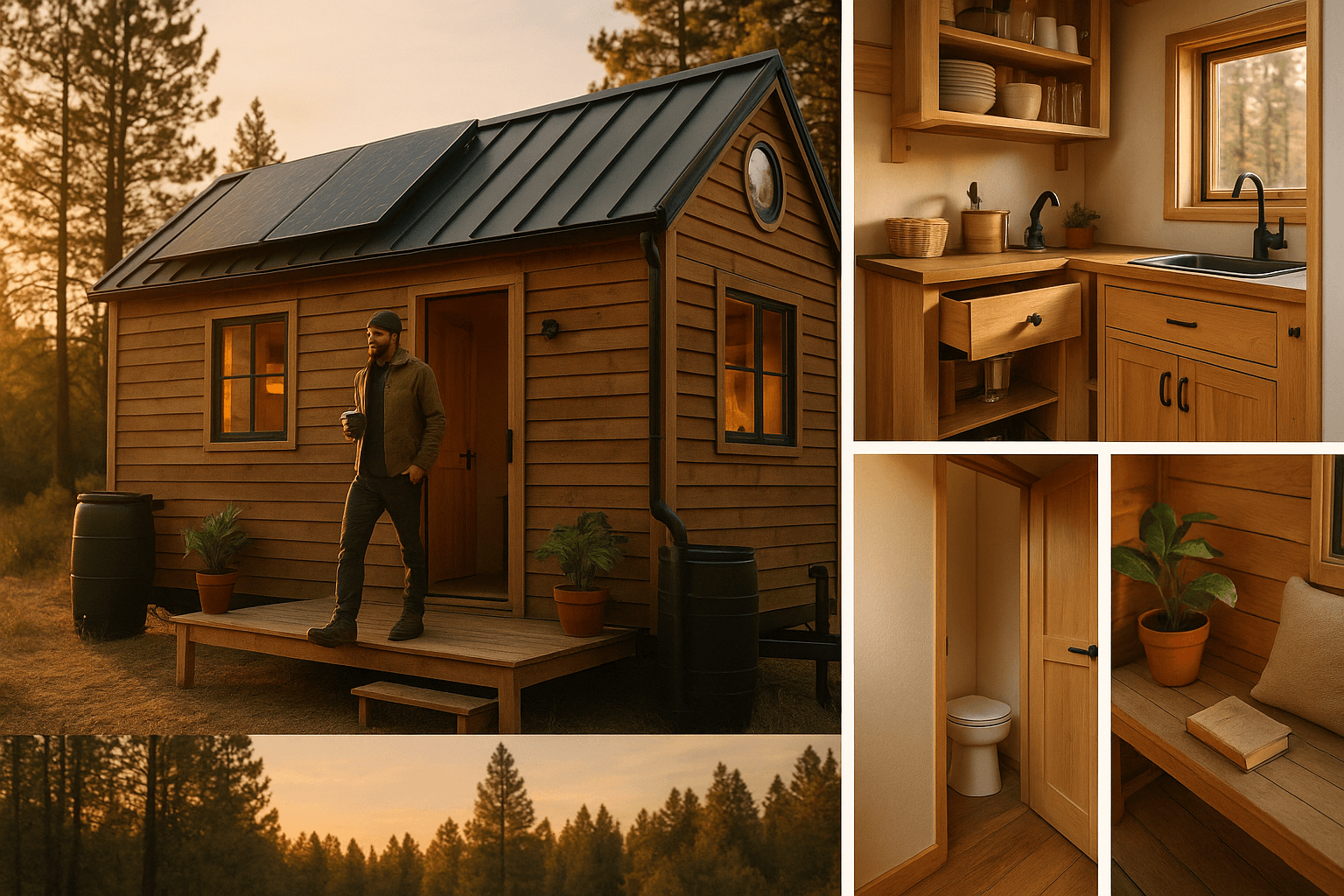
Off-grid for a tiny house doesn't mean "no modern life." It means your home can run without relying on utility hookups—power, water, and waste are handled by your own systems (and internet is planned like a real utility). The minimum basics to start are a right-sized power system (solar + battery + inverter), a water plan (source + storage + filtration), a waste plan (toilet + legal greywater handling), and a connectivity setup (cell or satellite + power budget).
At TinyHouses, we treat "off-grid" as a spectrum. When you design with our AI, you can choose grid-optional, hybrid, or fully off-grid, then we'll match the system to your climate, comfort level, and whether you're working remotely.
The off-grid spectrum: grid-optional → hybrid → fully off-grid
Most frustration comes from thinking off-grid is one fixed thing. It's not—your tiny house can be independent in some systems and still "touch the grid" occasionally.
Grid-tied (connected) — still can be resilient
What it means:
- Utility power + water + sewer (or septic)
- You may still have solar, battery backup, or generator
Who it fits:
- You want tiny living with maximum simplicity and easy permitting.
How TinyHouses helps:
- In our marketplace, filter for tiny homes with backup power (battery-ready, generator-ready) even if they're primarily grid-tied.
Grid-optional / hybrid (most common in real life)
What it means:
- You can operate independently for days to weeks
- You can also plug in or refill (campground pedestal, friend's property, water delivery, pump-out)
Example:
- Solar + battery covers daily living, but a small generator or shore power handles long storms.
How TinyHouses helps:
- TinyHouses AI recommends a starter off-grid package that matches your "days of autonomy" goal (2–3 days vs 7+ days).
Fully off-grid (indefinite, but still seasonal)
What it means:
- Designed to run long-term without utilities
- Reality check: seasonality matters (winter sun, freezing temps, water access)
Example:
- Large battery + oversized solar for winter, plus a reliable heat strategy and legally-compliant waste plan.
How TinyHouses helps:
- When you generate designs, specify winter lows, sun conditions, and occupancy so the AI doesn't under-size your system.
Power basics (solar + battery) in plain English
If you only remember one thing: your battery is sized in kWh (energy), not kW (power). Off-grid works when you plan both.
Key terms (practical definitions)
| Term | What it means | Why you care in a tiny house |
|---|---|---|
| Watt (W) / kilowatt (kW) | Instant power draw | Determines whether your inverter can handle peaks (kettle, microwave). |
| Watt-hour (Wh) / kilowatt-hour (kWh) | Energy used or stored over time | Determines how long you can run overnight/cloudy days. |
| Inverter | Converts battery DC → household AC | Must handle continuous and peak loads. |
| MPPT charge controller | Optimizes solar charging into batteries | Helps you get more usable charging, especially in variable sun. |
| Depth of discharge (DoD) | How much battery capacity is usable | LiFePO₄ often ~80–90% usable (varies by system). |
| Peak vs continuous loads | Short spikes vs steady draw | Peaks can trip inverters even if daily kWh looks fine. |
Typical tiny house daily energy use
Your daily total depends mostly on heating, hot water, and cooking.
- Minimalist cabin: lights, fridge, laptops → ~2–4 kWh/day
- Modern off-grid: WFH + efficient appliances → ~4–8 kWh/day
- All-electric including heat + hot water: often 10+ kWh/day (especially tough in winter)
Starter system ranges
For many starter off-grid tiny houses:
- Solar array: 800W–2,000W
- Battery storage: 5–15 kWh
- Backup: a small propane/gas generator is common for long cloud periods
Reality check: Space heating and hot water are the off-grid killers if electric. Many off-grid tiny homes use propane (or wood) for these big loads so the solar/battery system stays reasonable.
"Can I run that off-grid?" (load reality check)
- Electric kettle / microwave: big peak draw (inverter must handle it)
- Induction cooking: efficient, but can spike high—needs robust inverter + battery
- Mini-split heat pump: can work off-grid in mild climates; winter heating increases energy needs
- Starlink: steady draw + must be in your daily kWh budget
How TinyHouses helps: In the TinyHouses AI designer, select appliances (induction vs propane cooktop, mini-split vs propane heater, Starlink vs cellular). The AI suggests a right-sized power package—and you can compare it to real homes and builders in our marketplace.
Water basics: source → storage → treatment → freeze protection
Off-grid water isn't just "a tank." It's a chain—and the weak link is usually freezing or refill logistics.
Water sources
- Delivered/filled water: you haul or have it delivered (most common starter option)
- Well: best long-term independence, but needs drilling + pump + power
- Rainwater catchment: powerful where legal; requires filtration/disinfection and seasonal planning
- Surface water: possible, but needs robust treatment and legal consideration
TinyHouses note: Off-grid readiness in listings often hinges on the water plan. On TinyHouses, shop with practical filters in mind (tank capacity, four-season build, water system type).
Storage + usage anchors
- Common onboard fresh tank: 20–100 gallons
- Daily water use:
- Conservative tiny living (1–2 people): 10–25 gal/day
- Typical habits: 25–60+ gal/day
Big drivers: showers and laundry.
Minimum treatment stack (simple, reliable)
A practical baseline:
- Sediment pre-filter (protects pumps + downstream filters)
- Carbon filter (taste/odor, some chemicals)
- Disinfection if the source is uncertain (UV or chemical)
- Optional RO: great water quality, but wastes water and needs pressure
Winterization (where off-grid water fails most often)
Plan one of these approaches:
- Keep tanks/plumbing inside conditioned space
- Insulate + protect vulnerable lines
- Heat tape (works, but draws power)
- Drain-down capability if leaving the home
How TinyHouses helps: When you design with TinyHouses AI, specify winter temps and whether the home is stationary or towable. That changes recommendations for tank placement, insulation, and whether a drain-down system matters more than a giant tank.
Waste basics: toilet + greywater (and what's usually hardest)
Many people solve the toilet and forget the bigger headache: greywater legality and disposal.
Toilet options
| Option | Why people choose it | The trade-off |
|---|---|---|
| Composting toilet | Low/no water, flexible off-grid | Maintenance, venting, and compliant solids handling. |
| Incinerating toilet | Simple "output" (ash), low water | High energy use (propane/electric) + operating cost. |
| Cassette toilet | Easy install, common in mobile tiny/RVs | Frequent trips to dump stations. |
| Flush + septic | "Normal" living experience | Needs permitted septic or holding tank service. |
Greywater (sink + shower) is still there
Even with a composting toilet, you still produce greywater.
Common approaches:
- Greywater tank + pump-out (common for mobile/towable setups)
- Permitted greywater system/leach field (more common for stationary setups; highly jurisdiction-dependent)
How TinyHouses helps: In TinyHouses, narrow your search to homes that match your comfort level: composting-ready, septic-ready, or holding-tank-friendly. When you design with AI, we flag when your chosen setup is likely to require local permitting so you plan early, not after you buy.
Cooking + heating: propane vs electric (why most off-grid isn't all-electric)
Off-grid tiny houses work best when you electrify what's efficient and use propane/wood for high-heat loads—especially in cold or low-sun climates.
What propane commonly powers off-grid
- Cooktop/oven
- On-demand water heater
- Furnace/heater
- Backup generator (propane models exist)
What electric can do well (with the right system)
- Induction cooking (fast, clean—needs inverter/battery headroom)
- Mini-split heating/cooling (best in moderate climates; winter changes the math)
- Efficient refrigeration, lighting, device charging
Simple decision guidance (climate-first)
- Mild climate + good sun: more electrification is realistic
- Cold winters / long cloudy stretches: plan for propane/wood heat or a much larger solar+battery system
How TinyHouses helps: Our AI designer recommends "hybrid energy" packages (electric for daily life, propane for hot water/heat) based on your location and lifestyle—then you can compare those specs against real off-grid-ready models in the TinyHouses marketplace.
Internet off-grid: remote-work-ready setups
Off-grid shouldn't mean offline. Treat internet like a utility: plan coverage + redundancy + power draw.
Common solutions
- 4G/5G hotspot + external antenna: often the lowest power option, great where signal exists
- Starlink: strong option for remote areas; needs clear sky view + steady power budget
- Cell booster: helps where signal is weak (not magic—it needs some signal to amplify)
If you work from your tiny house: plan redundancy
A practical WFH mindset:
- Two ways to connect (e.g., cell + Starlink or two carriers)
- Battery budget for router/modem/dish
How TinyHouses helps: In TinyHouses AI, specify "WFH full-time" and your connectivity preference. That nudges the design toward the right electrical baseline and creates a listing checklist (Starlink mount location, router cabinet, antenna pass-through).
Legal + siting constraints (brief, but essential)
"Off-grid" is often limited less by technology and more by zoning, building code, and health department rules—especially for:
- Composting toilets
- Greywater disposal
- Septic permitting
- Rainwater harvesting legality
Also: mobile vs stationary changes everything. A towable tiny house may fall under RV-style rules in some places, while a stationary tiny house can be treated like a dwelling.
How TinyHouses helps: When you browse TinyHouses listings globally, focus on homes that match your intended use (rental try-out, towable, stationary) and avoid buying a setup that can't be legally used where you want to live.
The minimum basics to start: 3 starter off-grid packages
These are "minimum viable" starting points—not dream builds. Use them to pick a direction, then refine.
Package 1: Weekend / minimalist off-grid
Best for: 1–2 people, weekends, light device use
Power:
- Solar: 800W–1,200W
- Battery: 5 kWh
- Inverter: sized for modest peaks (skip high-draw appliances)
- Backup: optional small generator for bad weather
Water:
- 20–40 gal onboard tank
- Basic filtration (sediment + carbon); disinfection if uncertain
Waste:
- Composting or cassette toilet
- Greywater: tank + dump/pump-out plan
Internet:
- Cellular hotspot (external antenna if needed)
How TinyHouses helps: Use TinyHouses AI to design a tiny house that stays lightweight and towable, then filter marketplace listings for "simple off-grid" features (solar included, composting toilet, tanked water).
Package 2: Hybrid full-time (most common, most practical)
Best for: full-time living, moderate comfort, occasional plug-in/backup
Power:
- Solar: 1,200W–2,000W
- Battery: 10 kWh
- Backup: recommended (generator or occasional shore power)
- Heat/hot water: often propane to keep electrical reasonable
Water:
- 40–80 gal onboard tank (or larger stationary cistern)
- Filtration + disinfection as needed
- Winter plan: interior plumbing or freeze protection
Waste:
- Composting toilet or flush + holding tank
- Greywater: tank + pump-out or permitted system (stationary)
Internet:
- Cellular + optional Starlink as backup
How TinyHouses helps: TinyHouses AI recommends a hybrid package based on how many cloudy days you want to ride through. Then shop for homes that already match those specs—saving expensive retrofits.
Package 3: WFH + four-season off-grid
Best for: remote work, winter living, high uptime
Power:
- Solar: typically 2,000W+ (site-dependent)
- Battery: 15 kWh+ (especially for winter autonomy)
- Backup: strongly recommended
- Consider propane/wood for heat in cold climates unless you're oversizing solar/battery significantly
Water:
- Larger storage (onboard + external cistern if stationary)
- Robust treatment if using rain/surface sources
- Four-season insulation + freeze-resistant design
Waste:
- Choose based on legality first (septic/holding/compost)
- Greywater plan confirmed before you commit to a site
Internet:
- Starlink + cellular failover
- Dedicated power budget for networking gear
How TinyHouses helps: TinyHouses AI translates "I need Zoom reliability in winter" into system sizing and design choices (battery, inverter headroom, heating strategy). Then browse rentals to test the lifestyle before buying.
What breaks most often off-grid (and how to avoid it)
If you want off-grid to feel calm (not constant troubleshooting), design around these failure points:
- Under-sized power systems → avoid by budgeting for peaks (kettle/microwave) and cloudy-day autonomy
- Freezing water lines/tanks → avoid by keeping plumbing inside, insulating, and planning winter operations
- Greywater "oops" (no legal disposal plan) → avoid by deciding mobile vs stationary early and checking local rules
- No backup plan → avoid by keeping a generator option or plug-in capability for extreme weather
- Single-point internet → avoid by adding redundancy if you work remotely
How TinyHouses helps: We use these real-world failure patterns as prompts in the AI design flow—so your design isn't just pretty, it's livable.
How TinyHouses helps you choose the right off-grid package
Off-grid works when the system matches your life. With TinyHouses, you can:
- Design with AI by entering climate, occupancy, WFH needs, and appliance choices—then get a recommended off-grid baseline (power/water/waste/internet).
- Compare against reality by browsing our global marketplace for rentals and homes that already meet those specs—so you're not guessing or overbuilding.
Tiny house living is about finding what matters most. Our AI design generator lets you imagine any scenario—from location to style, possibilities are unlimited. Once you know what you want, start thinking of renting or buying. We can help with that too at TinyHouses.