10 Minimalist Habits That Actually Work in Tiny Houses (Plus 7 That Backfire)
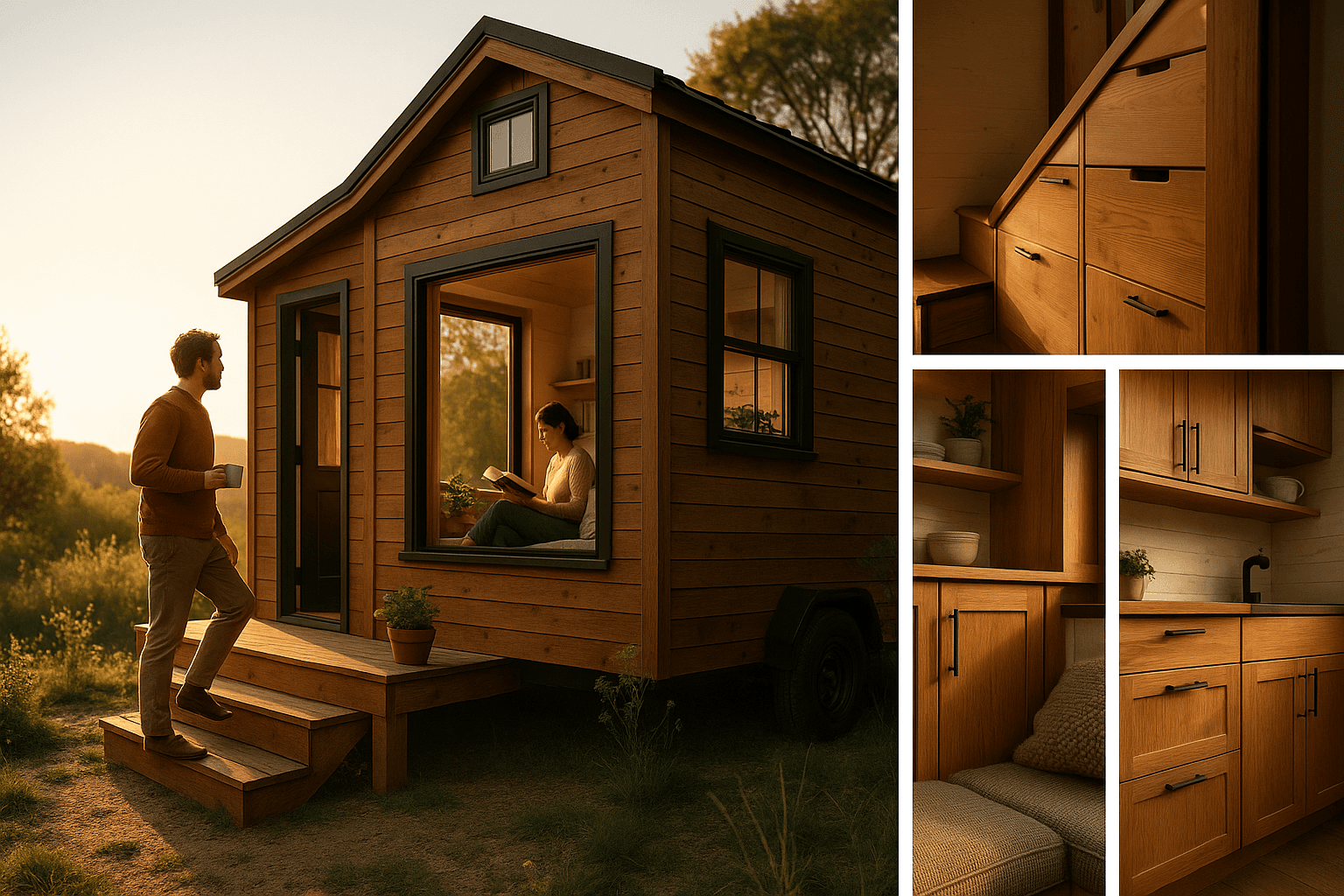
Minimalist habits only "stick" in a tiny house when your layout makes them automatic. In 200–400 sq ft, popular habits like "clear all surfaces" or "one-in/one-out" create clutter rebound and constant resetting—because you don't have buffer rooms, spare closets, or hidden storage.
What works instead: tiny-specific habits paired with micro-infrastructure (drop zones, charging drawers, cleaning workflows). And here's where TinyHouses AI changes everything: you can turn each habit into a design requirement, then generate floor plans that support your real life.
Why minimalist advice fails in 200–400 sq ft
Tiny houses compress your life into one visible scene. That changes everything:
- No-buffer reality: There's rarely a "later room." If something doesn't have a home, it becomes decor
- Limited full-height storage: Lofts, low ceilings, and fewer closets mean "out of sight" is harder
- Workflow collisions: Cooking, working, laundry, and entry/exit share the same surfaces
- Friction becomes clutter: If putting something away takes 3 steps, it will live on the counter
The TinyHouses filter (simple, but ruthless)
A minimalist habit works in a tiny home only if it has all four:
- Habit (what you do)
- Home (where it lives)
- Workflow (how easily it returns)
- Reset (how you recover when life gets messy)
TinyHouses AI lets you design these four into the plan from day one—rather than fighting the space after you move in.
7 minimalist habits that backfire in tiny houses
These aren't "bad habits." They're just written for people with hall closets and garages.
1) "Clear counters at all costs"
Why it backfires: You end up constantly re-homing essentials (coffee kit, knives, cutting board), creating a never-ending reset loop.
Do this instead: Create an Active Zone—a small, contained, intentional "counter life" area.
2) "One-in, one-out"
Why it backfires: It doesn't stop category creep. You can "one-out" a spatula and still end up with a drawer that won't close.
Do this instead: Use container limits by category (space is the rule).
3) "Buy matching bins so it looks minimalist"
Why it backfires: Pretty bins often waste volume (wrong depth, hard corners, inaccessible lids). In a tiny house, efficiency beats aesthetics.
Do this instead: Choose storage that is right-depth, vertical, and access-first.
4) "Everything should be multipurpose"
Why it backfires: You compromise high-frequency tasks. A "multipurpose" pan that's bad at everything becomes friction.
Do this instead: Keep a few single-purpose, high-use items that protect your routines.
5) "Digital minimalism will solve physical clutter"
Why it backfires: Cords, chargers, and devices multiply—then sprawl across the only table you have.
Do this instead: Make charging invisible by default.
6) "If it doesn't fit, you don't deserve it"
Why it backfires: Deprivation creates backlash. Tiny living isn't punishment; it's freedom.
Do this instead: Design for what you refuse to give up—then set boundaries.
7) "Donate it and re-buy if you need it"
Why it backfires: Tiny houses are often rural or off-grid-adjacent. Re-buying costs time, money, and shipping headaches.
Do this instead: Keep a tiny 'just-in-case' kit with hard limits.
The 10 minimalist habits that actually work in tiny houses
Each habit below includes the design requirement and TinyHouses AI prompt to generate a layout that supports it.
1) A real entry "drop zone" ritual
Habit: Keys, wallet, bag, shoes, leash go to the same place—every time.
Why it works: Prevents the "no-drop-zone effect" where daily items become counter clutter.
TinyHouses AI prompt: "Design a 320 sq ft tiny house with an entry drop zone: bench, shoe drawer for 6 pairs, 8 hooks, key tray, and narrow mail shelf."
2) The "two-step put-away" (temporary + permanent home)
Habit: Create one temporary landing (for today) and one permanent home (for storage).
Why it works: You stop creating random piles because the house supports real life, not perfection.
TinyHouses AI prompt: "Add a tiny landing shelf with a closed drawer beneath it near the entry for daily carry items."
3) Charging happens inside furniture, not on surfaces
Habit: Devices charge in one hidden spot; surfaces stay clear without effort.
Why it works: Cords are visual noise in a one-room home.
TinyHouses AI prompt: "Include a charging drawer in the kitchen or desk zone with built-in outlets, cable channels, and space for 6 devices."
4) Container-limit storage by category
Habit: You can own what you want—as long as it fits in the category container.
Why it works: Prevents category creep without deprivation.
TinyHouses AI prompt: "Create fixed storage limits: one drawer for kitchen gadgets, one cabinet for pantry overflow, one bin for pet gear, one shelf for hobby supplies."
5) Meal workflow minimalism
Habit: Cook with a repeatable flow: store → prep → cook → clean.
Why it works: Tiny kitchens fail when you need three surfaces and only have one.
TinyHouses AI prompt: "Design a tiny kitchen with a dedicated prep counter, pull-out cutting board, and pantry reachable without blocking the fridge or entry."
6) One cleaning caddy + one "cleaning closet footprint"
Habit: Cleaning supplies live in one grab-and-go kit.
Why it works: Small spaces are fast to clean only if tools are frictionless to access.
TinyHouses AI prompt: "Add a 12–16 inch wide cleaning closet: vertical storage for broom/mop, vacuum parking, and shelf for cleaning caddy."
7) Laundry as a loop
Habit: Treat laundry like a closed loop: collect → wash → dry → fold → store.
Why it works: Laundry becomes chaos when there's no place to stage, dry, or fold.
TinyHouses AI prompt: "Design a laundry workflow: hamper niche near bath, fold-down counter, and ceiling drying rail that doesn't block the main walkway."
8) Weekly "reset block," not daily perfection
Habit: Reset the house once a week (30–60 min), not constantly.
Why it works: Tiny living is intense if you aim for showroom tidy every night.
TinyHouses AI prompt: "Include a discreet reset station: one shelf or basket zone for items that need to be returned during weekly reset."
9) Dedicated parking for awkward items
Habit: Vacuum, yoga mat, guitar, stroller—each has a real parking spot.
Why it works: One awkward item left out makes the whole home feel cluttered.
TinyHouses AI prompt: "Add a tall 'awkward item' bay near the entry sized for vacuum + yoga mat + folding chair, with door or curtain."
10) A hobby boundary (not hobby elimination)
Habit: Keep the hobby you love—within a defined storage module.
Why it works: Deprivation fails; boundaries last.
TinyHouses AI prompt: "Create a dedicated hobby cabinet with slide-out bins sized for [climbing gear/art supplies/camera kit], with a hard volume limit."
Turn friction into floor plan upgrades
If you only do one thing from this article, do this: identify your top friction points, then design them out.
5 questions that reveal your layout requirements
- What do you drop first when you walk in?
- What must be reachable in 60 seconds after waking?
- What creates visual noise (cords, paper, jackets)?
- Which task creates the biggest mess?
- What won't you give up?
Use this template in TinyHouses AI
- "My tiny house is __ sq ft and needs an entry drop zone for: __."
- "I need hidden charging for __ devices and cable-free surfaces."
- "My cooking workflow requires: prep zone, pull-out counter, pantry access."
- "My laundry loop needs: hamper niche, fold-down surface, drying rail."
- "I need parking for awkward items: __."
- "I want hobby storage for: __ with a strict container limit."
TinyHouses makes this practical because you can iterate quickly: generate a concept, tweak one requirement, and compare versions before you build or buy.
Design calm, don't force it
The goal isn't "own less." In a tiny home, the goal is:
- Less friction (put-away is one step, not a project)
- Less visual noise (charging and papers have a hidden home)
- More flow (your daily routines don't collide)
- More freedom (because your home supports you, not the other way around)
When you design around your habits, calm becomes the default—not something you maintain with willpower.
Ready to design habits into your layout? TinyHouses AI turns your friction points into floor plan features. Try it at tinyhouses.to/design.