Minimalism in 2026 Isn't 'Less Stuff'—It's These 10 Tiny-Ready Skills
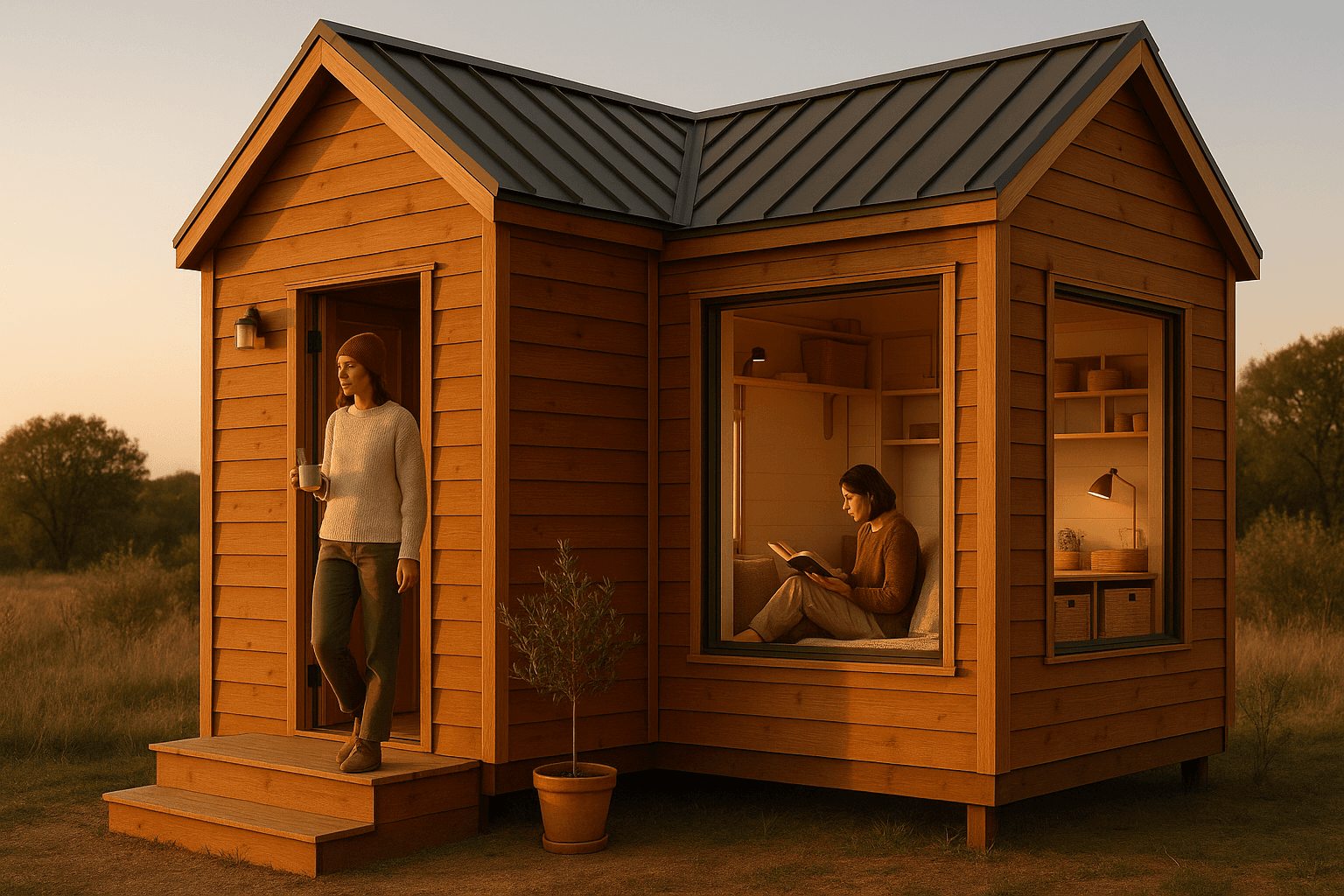
Minimalism in 2026 isn't about owning the fewest things—it's about running your tiny house like a calm, modern system. In 100–400 sq ft, your space has almost no "buffer zones," so tiny inefficiencies become daily friction. These 10 skills make tiny living feel effortless—because each one ties to a concrete outcome: clear counters, lower bills, fewer repairs, calmer mornings.
Each skill includes a TinyHouses "Design it in" callout—because the fastest way to make a habit stick is to design a layout where the right behavior is the easiest behavior. When you're ready, you can turn these skills into a real floor plan using our AI designer.
1) Storage Math (volume + access + frequency)
Tiny storage isn't about "more bins." It's about storage that you can actually use.
The skill: Apply storage math to every item:
- Volume: Does it fit without forcing?
- Access: Can you grab it with one hand (no unpacking a pile)?
- Frequency: Is it stored as close as its use frequency demands?
In tiny homes, a shallow drawer that's always jammed becomes negative storage—it costs time, counter space, and patience.
Tiny-house outcome:
- Counters stay clear because "put away" is truly one step
- You stop creating micro-piles because storage isn't a puzzle
Do it in 10 minutes (today): Pick one hotspot—usually the "junk drawer" or under-sink zone. Re-sort by frequency: daily items at eye/hand level, weekly items reachable but not prime, monthly/seasonal items high/low/deep.
Design it in with TinyHouses: Ask for full-extension drawers, not deep caves. Build vertical dividers for trays, boards, and lids. Design a single tall cabinet for brooms/vacuum + cleaning caddy so they don't live "wherever."
2) The 7-Minute Reset Routine (your tiny house "closing shift")
In a small footprint, you can't "clean later" because your surfaces are multi-use (desk = dining = prep). The skill isn't motivation—it's a repeatable closing shift.
A tiny-proven 7-minute checklist:
- 1 min: dishes into wash/dishwasher bin
- 1 min: wipe one main surface (the surface that blocks tomorrow)
- 1 min: quick floor sweep of the highest-traffic strip
- 1 min: re-home obvious roamers (use a basket if needed)
- 1 min: prep "morning friction reducers" (coffee/tea station, lunch box)
- 2 min: laundry basket + bathroom counter reset
Tiny-house outcome:
- Calmer mornings (the house isn't "in the way")
- You stop needing long cleaning sessions because the home never tips into chaos
Design it in with TinyHouses: Create a reset path (entry → kitchen → bath) with zero bottlenecks. Add a hidden-but-fast hamper (pull-out or tilt-out) near where clothes actually come off. Place a broom/vacuum within 5 steps of the main floor zone.
3) The Entry "Decompression Zone" (wet/dirty control)
Your entry is where tiny homes win or lose. If wet shoes and coats don't have an obvious home, they migrate—and once they migrate in 200 sq ft, they're everywhere.
The skill: Contain "wet/dirty" at the door with a decompression zone for shoes, coats, bags, pet gear, and rain gear.
Tiny-house outcome:
- Less mess spreads to the main floor
- Floors stay cleaner with dramatically less effort
Make it frictionless: Give each person 1 hook + 1 shoe slot. Add a "wet day" override: drip tray, towel hook, tiny mat.
Design it in with TinyHouses: Specify hooks for 4 items, a narrow bench, a drip tray, and a closed cabinet for messy gear. If you're designing a THOW (tiny house on wheels), keep this zone near the axle area for better weight distribution.
4) One-In/One-Out (without turning life into a guilt ritual)
Generic minimalism turns one-in/one-out into constant self-denial. Tiny-ready minimalism turns it into a steady-state system.
The skill: Use a Buffer List so decisions feel neutral, not emotional:
- Wish list: what you want next (so purchases are intentional)
- 14-day rule: if you still want it in two weeks, it's real
- Replacement-only categories: duplicates where tiny homes suffer most (mugs/water bottles, throw blankets, random "utility" items)
Tiny-house outcome:
- No purge cycles
- Less buyer's remorse (and fewer returns/deliveries)
Design it in with TinyHouses: Add a clearly labeled "Outbox" near the door (donate/return). Design a one-shelf "incoming" zone so new items don't explode across the table.
5) Digital Minimalism that reduces cables, subscriptions, and power draw
In tiny living, digital clutter becomes physical clutter: cables, chargers, boxes, backup drives. And yes—standby ("vampire") power is real: many devices draw power even when "off."
The skill: Run a quarterly digital utility audit:
- Cancel or downgrade subscriptions you don't actively use
- Consolidate devices (one laptop > laptop + tablet + old laptop)
- Remove redundant chargers/cables (keep one spare, not five)
- Set a power rule: one-switch shutdown for the whole tech cluster
Tiny-house outcome:
- Fewer cords on counters
- Lower power use (especially noticeable off-grid or on smaller electrical setups)
- Less decision fatigue
Design it in with TinyHouses: Build a single charging drawer/locker that hides cables. Place a switchable power strip or switched outlet circuit for the tech zone. Plan router placement so it's invisible-but-central (strong signal, no counter clutter).
6) Tiny Kitchen Flow (mise-en-place + fewer bottlenecks)
Tiny kitchens don't fail because they're small—they fail because the workflow is wrong. If one action blocks the next (drying rack blocks prep, trash blocks sink), cooking feels miserable.
The skill: Build a simple "daily cooking" flow:
- Clear-one-surface rule: before you start cooking, clear the one surface that matters
- Prep bin: one bin that holds oils/spices/knife/board while cooking (then disappears)
- Dish cadence: wash as you go in micro-bursts (30–60 seconds)
Tiny-house outcome:
- Cooking stays enjoyable
- You stop defaulting to takeout because the kitchen feels "too hard"
Design it in with TinyHouses: Add a pull-out prep surface (sliding counter, fold-down, or cutting board over sink). Design a dish-drying strategy (fold-down rack, over-sink rack, or drawer-style drying). Zone storage by frequency: daily tools within arm's reach of the prep zone.
7) Micro-Repair Confidence (the tiny toolbox + monthly rattle check)
Tiny homes—especially THOW—experience more vibration and movement than typical homes. That means fasteners loosen, caulk cracks, hinges drift. The "skill" is not being a contractor; it's being calmly capable.
Tiny toolbox essentials (small but mighty):
- Multi-bit driver + hex bits
- Small adjustable wrench
- Level (mini)
- Assorted screws + picture hooks
- Silicone caulk + caulk tool
- PTFE (plumber's) tape
- Stud finder (compact)
- Headlamp
Monthly rattle check (15 minutes):
- Tighten: cabinet pulls, hinges, table brackets
- Inspect: shower corners/caulk lines
- Listen/feel: any new squeaks near steps/loft ladder
Tiny-house outcome:
- Fewer emergencies
- Longer lifespan of your build
- Less "tiny home anxiety" because small issues don't become big ones
Design it in with TinyHouses: Specify an accessible tool drawer (not buried under the bed). Ensure service access panels exist for plumbing/electrical—ask the AI to include them; confirm with your builder.
8) Moisture + Air Habit Loop (ventilation triggers)
Moisture is amplified in tiny homes because you're cooking and showering in a small air volume. Humidity rises fast; condensation shows up fast.
The skill: Create ventilation triggers you don't have to think about:
- Fan on during showers + run it 15–30 minutes after
- Vent or crack a window when cooking (especially boiling)
- Quick condensation check: corners of windows, behind curtains, near the shower seam
Tiny-house outcome:
- Lower mold risk
- Better comfort (less "sticky air," fewer odors)
Design it in with TinyHouses: Place fan controls where you can't miss them. Choose easy-to-wipe wall materials near shower and cook zones. Ask for a layout with a cross-breeze option (window placement that actually moves air).
9) Energy + Water Awareness (without spreadsheet life)
You don't need a dashboard obsession. You need a few behaviors that matter because in tiny living—especially off-grid-leaning setups—small waste is immediately noticeable.
Energy (big levers):
- Heating/cooling usually dominates; insulation + air-sealing + simple habits beat gadgets
- Close curtains at night; ventilate at the right time of day
- Kill standby power with one switch for entertainment/office zones
Water (behavior-driven):
- Basin method for dishes (wash basin + quick rinse)
- Spray bottle pre-rinse for stuck-on food (less running water)
- 30-second leak check: look under sink + around toilet connections
Tiny-house outcome:
- Lower bills
- Strong off-grid readiness without feeling deprived
Design it in with TinyHouses: Make shutoff valves easy to reach (not hidden behind a full drawer). Design lighting circuits so "everything off" is natural at the door. Add a simple spot for an optional monitor or analog notes—whatever matches your personality.
10) The Tiny Ops Calendar (weekly, monthly, seasonal)
Tiny living is easier when maintenance is predictable. The skill is turning "I should…" into a tiny schedule you barely notice.
Weekly (10 minutes):
- Empty compost/trash
- Wipe high-touch surfaces
- Check entry zone (wet gear reset)
Monthly (30 minutes):
- Rattle + seal check
- Clean fan covers/filters
- Inspect window condensation points
Seasonal (1–2 hours):
- Roof/exterior inspection
- Re-caulk touch-ups if needed
- If THOW: verify tire pressure and visible fasteners (use your builder's checklist)
Tiny-house outcome:
- Fewer surprise costs
- Less stress because you're never "behind" on the home
Design it in with TinyHouses: Build a tiny "ops station": a clipboard hook, slim cabinet, or a single drawer for manuals + spare filters. Include service access that makes inspections possible without moving furniture.
The hidden causes of mess in tiny spaces
If your tiny home keeps getting messy, it's usually not laziness—it's one of these structural problems:
- No landing zone (stuff enters the home and has nowhere to stop)
- Storage without access (you can store it, but you can't retrieve it cleanly)
- Wet stuff has no home (coats, towels, shoes become traveling clutter)
- No "outgoing" system (returns/donations pile because leaving requires a plan)
- Multi-use surfaces have no reset ritual (table becomes everything, so it becomes chaos)
TinyHouses' advantage is that we can take these problems and translate them into a layout brief—so your house reduces friction by default.
TinyHouses AI design prompt pack
Paste these into the TinyHouses AI Generator to create habit-first layouts that support the skills above:
Reset Routine Layout: "Design a tiny house interior optimized for a nightly 7-minute reset: clear counters, a single cleaning caddy location, broom storage, and a re-home path from entry to kitchen to bath. Show where each item 'lives'."
Entry Decompression Zone: "Include an entry zone that contains wet shoes/coats/bags: hooks for 4 items, a bench, a drip tray, and a closed cabinet for messy gear. Prioritize keeping dirt from reaching the main floor."
Low-Device, Low-Cable Digital Setup: "Design a single charging station that hides cables (drawer or locker), supports 2 laptops + 2 phones, and can be switched off to eliminate standby power. Place router for best coverage without clutter."
Tiny Kitchen Flow: "Create a tiny kitchen layout that supports cooking daily with minimal counter space: specify a pull-out prep surface, a dish-drying solution, and zones for knives, spices, and pots based on frequency of use."
Maintenance-First Build: "Prioritize easy maintenance access: service panels for plumbing/electrical, tool storage near likely repair points, moisture-resistant materials in bath/kitchen, and ventilation controls that are easy to reach."
Energy/Water Awareness: "Add a simple monitoring nook for tracking energy/water habits: place shutoff valves accessibly, include space for a small monitor or analog notes, and design lighting circuits for easy shutoff."
One-In/One-Out Outbox: "Include a dedicated 'outbox' near the door (donation/return box) that's visually contained but convenient, sized for a week of outgoing items."
Storage Math Layout: "Design storage using 'frequency zones': daily items at hand height, weekly items in reachable cabinets, seasonal items in high/low storage. Use full-extension drawers and vertical dividers to avoid jammed storage."
Start designing your habit-first tiny home
TinyHouses' AI design generator lets you imagine any scenario—from location to style, possibilities are unlimited. Once you know what you want, you can start thinking of renting or buying. We can help with that too.